Songs & Playing
Chord Charts vs Sheet Music: Two Ways to Play a Song
Learn the difference between chord charts and sheet music for piano, when to use each, and how the same song looks in both formats.
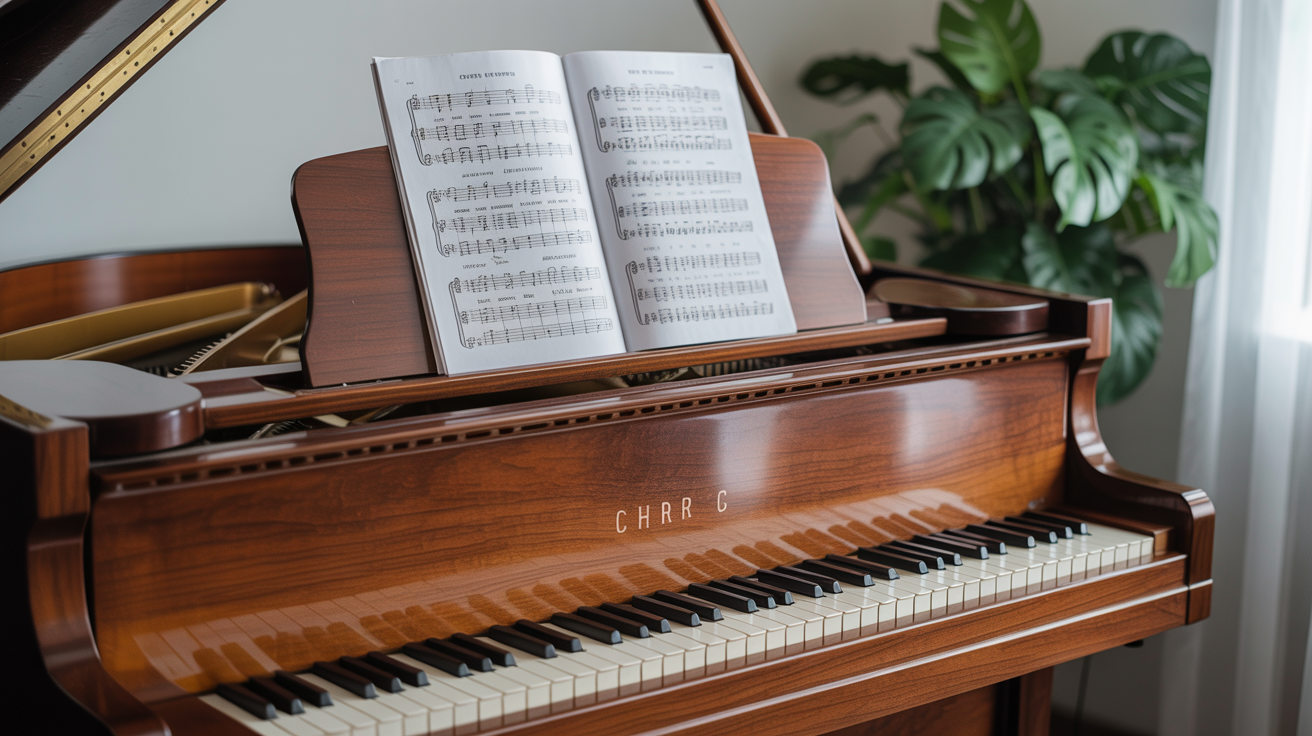
When you want to learn a new song on piano, you have two very different starting points: full sheet music or a chord chart. Both will get you playing the song, but they ask completely different things of you as a player. Understanding what each one gives you, and what it leaves out, helps you pick the right format for where you are right now and what kind of playing you want to do.
This guide explains chords vs sheet music for piano from scratch. No prior music theory assumed.
What sheet music actually shows you
Sheet music (sometimes called "notated music" or a "score") is the full written-out version of a song. Every single note is printed, in order, with its exact duration. The treble clef staff (the upper one) shows what your right hand plays; the bass clef staff (lower) shows your left hand. Time signatures and dynamic markings tell you how fast and how loud.
When you read sheet music, you are following a precise map. The arranger made decisions about every detail: which inversion of each chord to use, what the bass line does on the off-beats, how the melody fills in the gaps. You reproduce those decisions, note for note.
For a beginner learning from sheet music, two main skills are being built simultaneously:
- Note reading: recognizing pitches on the staff
- Rhythm reading: interpreting note durations (quarter notes, half notes, dotted rhythms, etc.)
That is a lot to track at once. Most beginners find sheet music slower to learn from initially, but the payoff is precision. Once you have learned a piece from sheet music, you can reproduce it exactly the same way every time.
What a chord chart (or lead sheet) shows you
A chord chart lists the chords of a song, usually with the melody written above, and chord symbols placed where each chord change happens. A chord symbol is a letter (and sometimes numbers or extra letters) that names a chord: C, Am, G7, Fmaj7. Each symbol tells you which notes to play together with your left hand.
A lead sheet is a specific type of chord chart that adds the written melody on a staff above the chord symbols. You read the melody in your right hand and play the indicated chord in your left.
What a chord chart does NOT tell you:
- Which notes of the chord to play in which order (called voicing)
- What rhythm to use in your left hand
- Whether to arpeggiate, block, or otherwise pattern the chord
Those choices are yours. That is both the freedom and the challenge. Two pianists reading the same chord chart can sound very different from each other.
How the same song looks in both formats
Take a simple four-bar phrase from a pop song in C major. The chord progression is C, Am, F, G.
In full sheet music, bar one might show: right hand plays the melody note E (quarter note) on beat one, D (quarter note) on beat two, C (half note) on beats three and four. Left hand plays C-E-G as a block chord on beat one, then holds.
In a chord chart or lead sheet, bar one shows the letter "C" above beat one. That is it. You decide to play C-G-C in the left hand, or to arpeggiate C-E-G upward, or to play C in the bass and walk up to the next chord.
Neither version is wrong. They are different tools.
Comparison: sheet music vs chord charts for beginner piano players
| Feature | Full sheet music | Chord chart / lead sheet |
|---|---|---|
| Every note written out | Yes | No; melody only (lead sheet) or nothing (chart) |
| Left-hand rhythm specified | Yes | No |
| Note-reading required | Yes | Melody only (lead sheet); minimal (chart) |
| Flexibility to improvise | Very little | High |
| Good for classical pieces | Yes | No |
| Good for pop, jazz, folk | Yes | Yes |
| Typical learning speed | Slower at first | Faster for chord-based songs |
| What transfers to other songs | Note-reading skill | Chord knowledge and comping patterns |
When to use sheet music
Sheet music is the right choice when:
The arrangement matters. Classical pieces, musical theatre songs, and film scores are written with specific bass lines, inner voices, and ornaments that are part of the piece itself. Playing Chopin from a chord chart would miss the point entirely.
You want to develop reading skills. If your long-term goal is to sight-read confidently or play from published arrangements, practicing sheet music is how you build that.
You want a reproducible, finished performance. Learning a piece for a recital, a wedding, or an audition is much easier when the notes are written down. You practice the same thing every time.
If you are working through a collection of easy piano songs for beginners, many are available in simple sheet music arrangements that strip out complex rhythms without requiring you to invent anything.
When to use a chord chart
Chord charts make more sense when:
The song is chord-based by nature. Most pop, rock, country, folk, and jazz songs were written as chords first, with a flexible accompaniment. The chord chart is closer to how the song actually works.
You want to learn songs quickly. If you already know the melody by ear, a chord chart lets you start playing along within minutes. You need to learn maybe four to six chords, not fifty-plus individual note positions.
You want flexibility. Chord charts let you play the same song in a stripped-down version for a quiet night at home or a fuller version when you have more confidence.
You are playing by ear or improvising. Understanding chord charts is a direct on-ramp to playing by ear. The two skills reinforce each other. If that interests you, how to play piano by ear: a beginner's starting point goes into detail on that connection.
A practical way to start with chord charts
If you have never played from a chord chart before, start with triads (three-note chords). A C major chord is C, E, and G played together. An A minor chord is A, C, and E. Learn four chords (C, Am, F, G) and you can play the left-hand accompaniment to dozens of pop songs.
Your left hand plays the chord, usually once per bar or on beats one and three. Your right hand plays the melody, which you either read from a lead sheet or know from memory. The two hands have distinct jobs and do not mirror each other.
Building a complete piece from either format
Whether you start from sheet music or a chord chart, the actual process of learning a piece is similar: slow it down, learn each hand separately, then combine them. For a step-by-step method, how to learn a new piano piece from start to finish covers that process in detail.
One thing worth knowing: learning from chord charts does not mean you skip learning to read music eventually. Many pianists use both formats depending on the situation. Classical practice time might be from sheet music; jamming with friends or learning a new pop song might be from a chord chart. The skills complement each other rather than compete.
Frequently Asked Questions
Can I learn piano using only chord charts, without reading sheet music?
Yes, and many players do exactly that. Plenty of working musicians, session players, and singer-songwriters read chord charts but not traditional notation. The trade-off is that your repertoire will lean toward pop, folk, and jazz styles, and pieces that require precise classical arranging will be harder to access without notation. If your goal is to play songs at home and maybe accompany others, chord charts alone can take you a long way.
What is a lead sheet and how is it different from a chord chart?
A lead sheet includes the melody written on a musical staff (usually just the treble clef), with chord symbols written above the staff at each chord change. A plain chord chart has only the chord symbols, sometimes with lyrics, but no staff notation at all. Lead sheets are common in jazz and musical theatre; plain chord charts are common in pop, country, and rock contexts. Either can work at the piano; the lead sheet just gives you more information about the melody.
Do I need to know music theory to use a chord chart?
Not much, but a little goes a long way. You need to know what the chord symbols mean: that C is a C major triad, that Am is A minor, that G7 adds a seventh interval to your G major chord. You can memorize these shapes on the keyboard without understanding the theory behind them. But if you spend a few minutes learning why those chords are built the way they are, you start recognizing patterns that appear across dozens of songs, which speeds everything up considerably.
Why does the same song sound different when two people play it from the same chord chart?
Because the chart only specifies the chords, not how to play them. One person might play block chords on every beat; another might arpeggiate on a steady eighth-note pattern; a third might use a syncopated rhythm. The chord quality (major, minor, seventh) is the same for both players, but the texture, rhythm, and voicing are personal choices. This is one of the more appealing things about playing from charts — your version sounds like you.
Should I start with sheet music or chord charts as a complete beginner?
It depends on what you want to play. If you are drawn to classical music or hymns, or want to read music fluently over time, start with sheet music. If you want to play pop songs, accompany yourself singing, or jam informally, start with chord charts. Many beginners find chord charts less overwhelming at first because there are fewer decisions to decode at once. Adding some note-reading practice early (even just five minutes at the end of each session) means you do not have to relearn from scratch if you later decide you want both skills.