Songs & Playing
How to Add Dynamics and Expression to Your Playing
Learn piano dynamics for beginners: how to control loud and soft, shape phrases, and add real musical expression to your playing from day one.
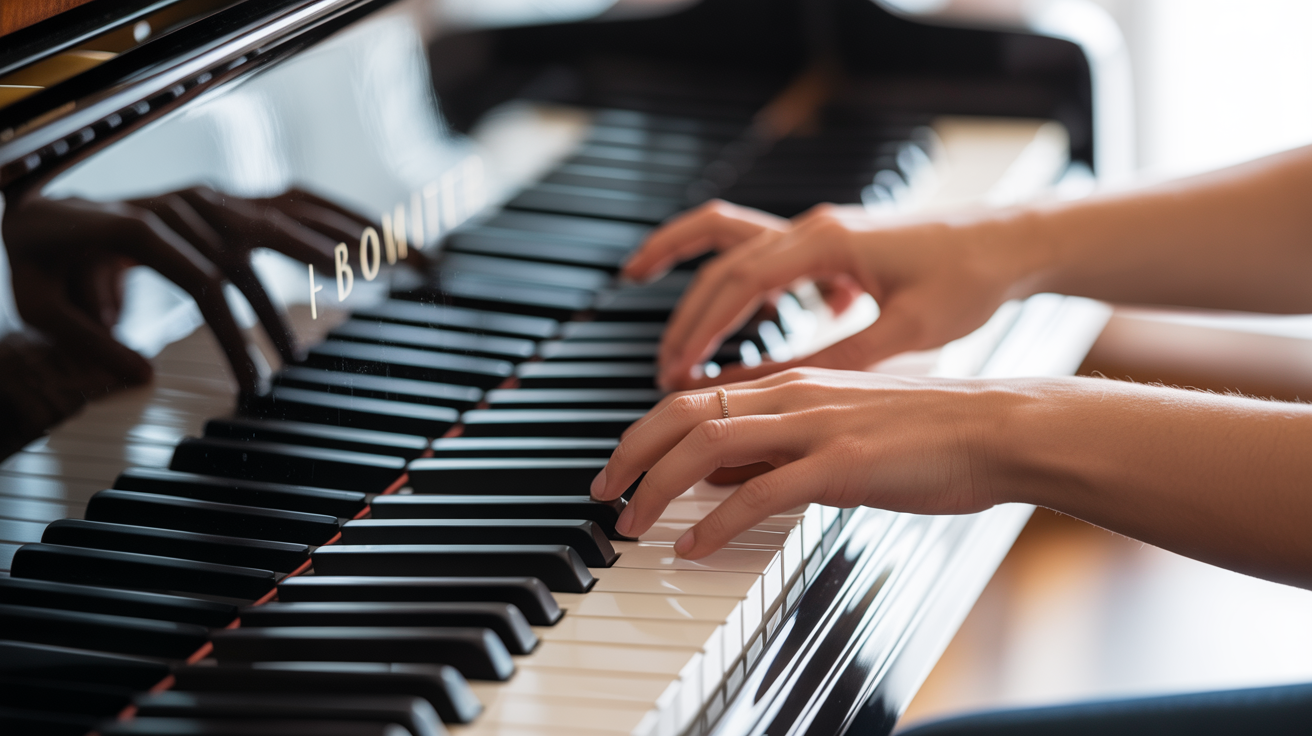
Dynamics are how loud or soft you play. They're also one of the fastest ways to make a simple piece sound genuinely musical. A beginner who plays the same melody twice, once flat and once with shape, will notice the second version feels alive. This guide explains what dynamics are, how to control them physically, and how to start applying them to real music.
What Piano Dynamics Actually Mean
In sheet music, dynamics are marked with Italian abbreviations. You'll see these constantly once you start reading scored pieces.
| Symbol | Italian | Meaning |
|---|---|---|
| pp | pianissimo | very soft |
| p | piano | soft |
| mp | mezzo-piano | moderately soft |
| mf | mezzo-forte | moderately loud |
| f | forte | loud |
| ff | fortissimo | very loud |
| < (hairpin) | crescendo | gradually louder |
| > (hairpin) | decrescendo | gradually softer |
For a beginner, you don't need to nail six levels right away. Start with three: soft, medium, and loud. Getting those three to actually sound different is already a skill worth building.
How Touch and Weight Create Volume
The piano is a percussion instrument. When you press a key, a felt hammer strikes a string. The speed of that hammer determines the volume, not the force you hold the key down with. Once the key is fully pressed, holding harder does nothing.
What this means in practice: louder playing needs faster key travel. Softer playing needs slower key travel.
Playing Softly
For quiet notes, your finger should approach the key slowly and with very little arm weight behind it. Rest your fingers lightly on the keys before you play, then press down in a slow, controlled way. The finger does the work; the arm stays relaxed.
Beginners often tense up trying to play quietly. The opposite helps. Let the hand be loose. A stiff hand tends to accidentally over-press.
If your soft notes keep cutting out entirely, the key isn't being pressed far enough down to trigger the hammer. Aim for a consistent, gentle press rather than a creeping one that never quite completes.
Playing Loudly
For forte passages, use arm weight. Instead of hammering down with just the finger, let your forearm drop toward the key. The weight of the arm, combined with a firm finger, produces a full sound without strain.
Avoid the temptation to raise your hand high above the keys and then slam down. That approach leads to tension and uneven tone. Keeping the hand close to the keys and using arm weight gives you more control over how loud you actually get.
A useful experiment: play a single note at what feels like your loudest, then try to play it at 80% of that. The second version often sounds just as full, with better tone.
Shaping Phrases
A phrase is a musical idea, roughly like a sentence. Most phrases have a natural peak, a moment where the melody or harmony reaches its highest point before coming back down. Playing through that shape, by getting slightly louder toward the peak and softer on the way down, is one of the most direct ways to make music feel like it breathes.
Here's a simple way to find the phrase shape in a piece:
- Hum the melody. Where does it naturally feel like it lifts?
- That lift is usually the dynamic peak.
- Play the phrase again, letting your volume match the contour of the hum.
You don't need to mark every note with a specific dynamic. The goal is a gentle arch, not a dramatic roller coaster. Exaggerate it at first in practice so you can hear the difference, then pull back to what sounds musical.
Internal links note: once you've built a sense of phrasing, you can apply it immediately to easy piano songs for beginners. The process of adding dynamics to a piece you already know is also a core part of how to learn a new piano piece from start to finish.
Practical Exercises for Dynamic Control
The Five-Finger Scale at Three Volumes
Take your right hand and play a five-finger scale (C-D-E-F-G and back) at three volumes: soft, medium, loud. Each note should stay consistent within a volume level. Repeat until the transitions between levels sound clear and reliable.
Once that feels stable, add transitions. Play the scale up loudly and return softly. Then start soft, get louder by the top, and come back down soft again.
One Note, Five Levels
Pick any single key. Play it ten times in a row, starting at your quietest and working up to your loudest. Try to hear a clear, even step between each hit. This trains the hand to produce a range, not just an on-off switch.
The Hairpin in a Simple Melody
Find a melody you can already play hands together, something you've worked on recently. Pick one four-bar section. Add a crescendo through the first two bars, and a decrescendo through the last two. Listen back and adjust. The hairpin doesn't need to start from silence or end there. A slight swell is often more musical than an extreme one.
Tempo and Rhythm as Expression Tools
Dynamics are one layer of expression. Two others show up alongside them: tempo fluctuation and articulation.
Tempo fluctuation (rubato) means stretching or compressing time slightly for effect. A pianist might linger on the peak of a phrase, then move forward again. Classical music uses this heavily; it's also present in everything from pop ballads to jazz. For beginners, the main skill is learning to come back to the pulse after a stretch. The beat doesn't disappear; it bends and returns.
Articulation refers to how notes connect or separate. Staccato notes are short and detached. Legato notes are smooth and connected. Playing a phrase legato at medium volume feels very different from playing it staccato at the same volume. The right articulation for a passage is often marked in sheet music, but when it isn't, listening to recordings and making a choice is part of interpretation.
If you're learning pieces by ear, these expressive tools apply there too. How to play piano by ear covers the listening habits that make this easier.
Frequently Asked Questions
Can I add dynamics on a cheap keyboard? Most digital keyboards and pianos respond to velocity, meaning how fast the key travels down. If yours has weighted or semi-weighted keys, you have reasonable dynamic control built in. Full-size unweighted keys often have limited response, which makes subtle dynamic control harder. Check your keyboard's manual to see if it has velocity-sensitive keys. If it does, the exercises above will work fine.
How do I know how loud "forte" actually is? There's no fixed decibel level. Forte means loud relative to the other dynamics in that piece and in the room. On a full grand piano in a concert hall, forte is enormous. On a small keyboard at home, forte is just a clear, full sound. Listen to professional recordings of the piece you're working on to get a sense of the intended contrast.
My soft playing sounds muffled. What am I doing wrong? Muffled quiet notes usually mean one of two things: the key isn't being depressed fully, so the hammer barely strikes the string, or the sustain pedal is catching unwanted resonance from previous notes. Try playing a soft note without the pedal first. If it sounds clean, the issue is pedaling. If it still sounds dead, focus on pressing the key slightly more deliberately even at low speed.
Should I add dynamics while I'm still learning the notes? Ideally, no. Work through the notes, fingering, and rhythm first. Once a passage is reliable, layer in dynamics. Trying to manage too many variables at once usually means none of them get done well. That said, if a piece has a very obvious dynamic contrast written in, like a forte chorus followed by a piano verse, keeping that contrast from the start can help you remember the structure.
Is expression something you feel, or something you plan? Both. Planning helps, especially early on, because feeling alone often leads to playing everything the same way. Mark the phrase peaks in your score. Decide where the crescendos go. Then, as the piece becomes comfortable, the plan recedes and the feeling takes over. Most experienced players still mark scores, but they no longer think about each mark while playing.