Chords & Harmony
How to Read Chord Symbols and Lead Sheets
Learn how to read chord symbols like C, Cm, C7, and Cmaj7 on a lead sheet. A plain-language guide for beginner pianists.
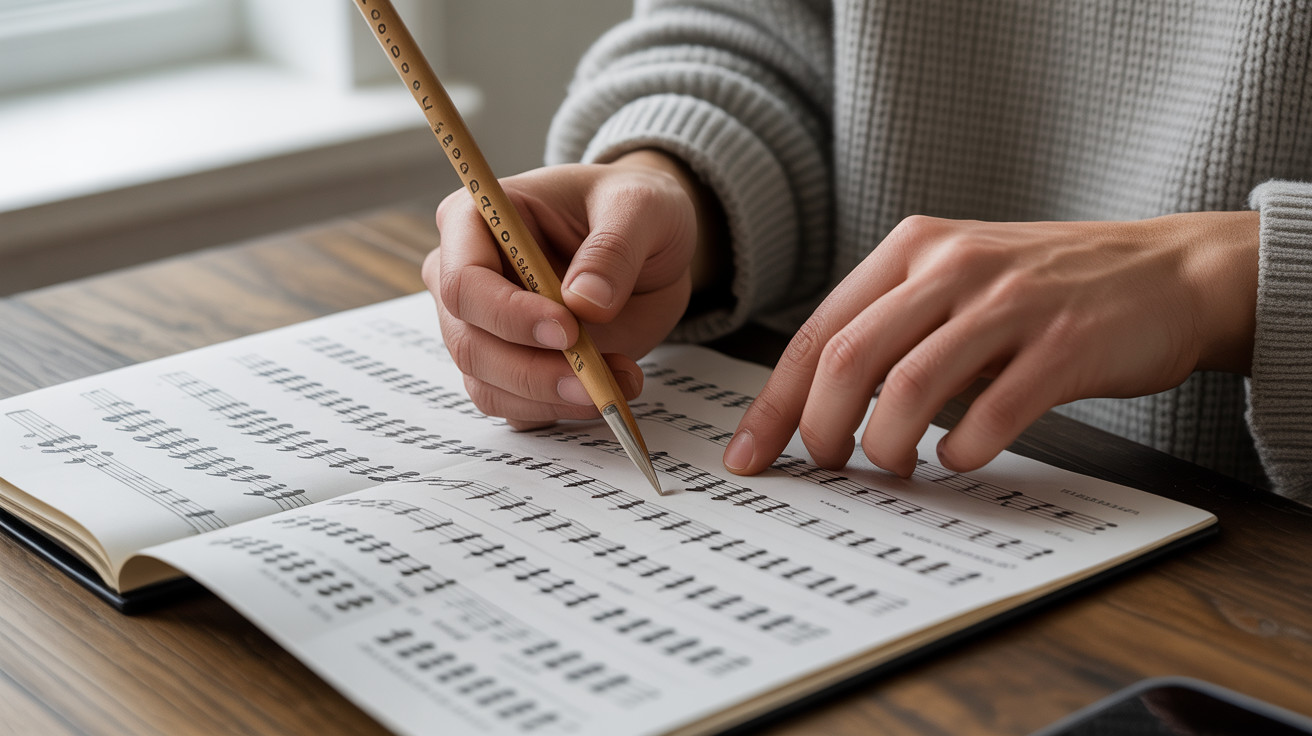
If you've ever looked at sheet music that shows a melody line with letter names floating above it (C, Am, G7), you were looking at a lead sheet. Knowing how to read chord symbols is one of the most practical skills a beginner can pick up, because it lets you play from a huge library of songs that would otherwise feel inaccessible. This guide walks through every common symbol you'll encounter and shows you what to actually do with your left hand.
What is a lead sheet?
A lead sheet is a condensed form of sheet music that gives you two things: the melody written on a staff, and chord symbols printed above the staff showing what harmony belongs with each measure (or beat). It leaves the accompaniment up to you.
Here's a simple example. Imagine the melody to "Happy Birthday" written as notes on a treble clef staff. Above the first measure you'd see a C, above a later measure you'd see a G7, and later F. Your right hand plays the melody notes on the staff. Your left hand plays the chord named by the symbol.
Lead sheets are the standard format in jazz, pop, folk, and musical theater. The Real Book, which pianists have used for decades to play jazz standards, is essentially hundreds of lead sheets bound together. Once you can decode the symbols, you can sit down with almost any of those tunes.
The anatomy of a chord symbol
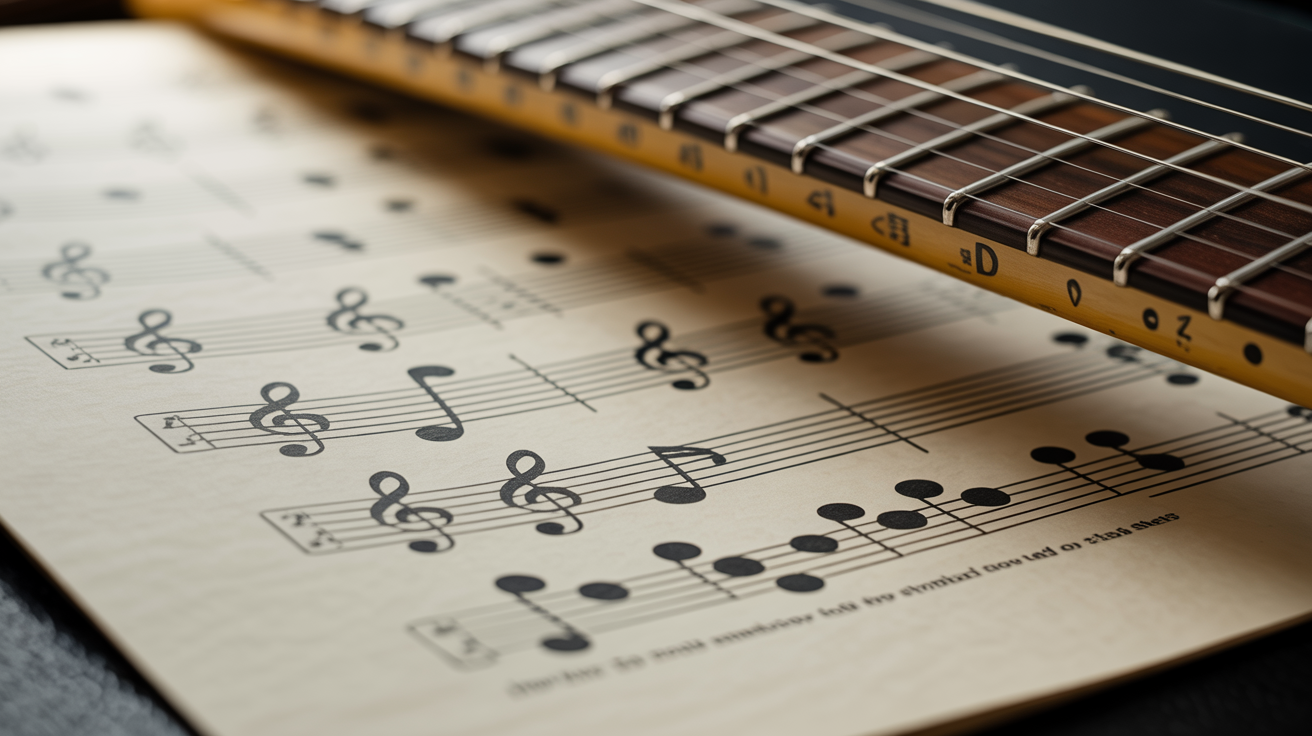
Every chord symbol has two parts: a root note and a quality modifier.
The root is a capital letter: A, B, C, D, E, F, or G (with sharps or flats added when needed, like Bb or F#). That letter tells you the lowest note of the chord and the note that gives the chord its name.
The quality modifier is everything that comes after the root letter. It tells you which intervals to stack on top of the root. No modifier at all means a plain major chord. A lowercase "m" means minor. Numbers like 7 or 9 add extra notes. Here's how the most common modifiers break down:
| Symbol | Name | What it means |
|---|---|---|
| C | C major | C + E + G |
| Cm | C minor | C + Eb + G |
| C7 | C dominant seventh | C + E + G + Bb |
| Cmaj7 | C major seventh | C + E + G + B |
| Cm7 | C minor seventh | C + Eb + G + Bb |
| Cdim | C diminished | C + Eb + Gb |
| Caug or C+ | C augmented | C + E + G# |
| Csus4 | C suspended fourth | C + F + G |
| Csus2 | C suspended second | C + D + G |
| Cadd9 | C add nine | C + E + G + D |
A few things to notice. The "7" in C7 is a flatted (minor) seventh: Bb, not B. That's why C7 and Cmaj7 sound different even though both contain "a seventh." The maj7 symbol specifically asks for the natural seventh (B). If you mix those two up, the chords will clash noticeably with the melody.
The "sus" chords replace the third entirely. Csus4 has no E; the F takes its place. Suspended chords sound unresolved on purpose; they almost always move to the plain major or minor version a beat later.
What Cm means on the piano
New players often ask: what does Cm mean? It means C minor, which is C, Eb, and G played together. The only difference between C major (C–E–G) and C minor (C–Eb–G) is that the middle note drops by one half step, from E down to Eb. That one semitone makes the chord sound noticeably darker.
When you see Cm on a lead sheet, your left hand plays those three notes. How you voice them (which octave, which arrangement) is up to you. A common beginner approach: play C with your pinky, Eb with your middle finger, and G with your thumb, all in the octave below middle C.
If you want to go deeper on building these shapes, piano chords for beginners covers the first triads worth learning in more detail.
Slash chords: what C/E means
A slash chord looks like a fraction: C/E, G/B, Am/C. The letter before the slash is the chord. The letter after the slash is the bass note. They aren't the same thing.
C/E means: play a C major chord, but put E in the bass (the lowest note) instead of C. On the piano, your left hand plays E in the low register while your right hand (or left hand upper notes) plays C–E–G. The result is a smoother sound than a regular C chord because E connects naturally to the notes around it.
Slash chords appear constantly in pop and film music as a way to create a walking bass line while keeping the same chord in the upper voices. If you see a sequence like C, C/B, Am, Am/G, your left hand is simply stepping down: C, B, A, G on successive beats. The harmony barely changes; the bass line does all the movement.
A few to know:
| Slash chord | Chord | Bass note | Common use |
|---|---|---|---|
| C/E | C major | E | Smoother root position |
| G/B | G major | B | Connects G to C |
| Am/C | A minor | C | Connects Am to G or F |
| D/F# | D major | F# | Ascending bass line |
You don't need to memorize all of these at first. When you see a slash chord, just remember: left hand plays the note after the slash, right hand plays the chord before the slash.
Reading chord symbols in real time
When you play from a lead sheet, your eyes are doing two things at once: reading the melody notes on the staff and watching the chord symbols above for when they change. This takes practice, but there's a reliable approach.
Start by scanning the whole lead sheet before you play. Notice where chords change. Some chords last a whole measure; some switch on beat 3; occasionally two chords share a measure, one on beat 1 and one on beat 3.
Then practice the left hand alone. Play through the chord changes without the melody, just holding or arpeggating each chord until you feel comfortable moving between them. Common chord progressions is worth reading at this stage, because a lot of lead sheets recycle the same handful of progressions.
Once your left hand knows where it's going, add the melody in your right hand. Your left hand should feel almost automatic so your attention can stay on the melodic line.
One more thing: chord symbols don't tell you exactly how long to hold each note or how to rhythmically pattern the left hand. That's your job. You might play straight block chords, or you might arpeggiate from low to high, or play a bass note followed by the upper notes of the chord in a waltz pattern. The lead sheet gives you the raw material; the arrangement is yours to decide.
Extensions and alterations: 9ths, 11ths, and beyond
Once you're comfortable with basic chord symbols, you'll start seeing numbers beyond 7: C9, Dm11, G13, or altered chords like G7#5 or G7b9.
These extensions add notes beyond the octave. A C9 chord is C7 with the note D added on top (the ninth, which is D an octave above the second). A C13 theoretically stacks notes all the way up to the thirteenth, though in practice pianists leave out the 11th to avoid a clash.
For beginners, the most practical approach: play the basic triad or seventh chord you already know, and optionally add the extension if your hand has room. A G9 voiced as G–B–F–A sounds full and jazzy; a plain G7 in the same spot is perfectly acceptable.
Altered chords (the ones with #5, b9, #11, and so on) raise or lower specific chord tones by a half step to create tension. G7#5 is G–B–D#–F. These are more common in jazz lead sheets than in pop. If you see one and aren't sure what to do, playing the plain G7 underneath a jazz melody will get you through.
To understand why these extensions work the way they do, it helps to have a solid grip on triad construction first. How to build major and minor triads explains the interval math behind every chord.
Frequently Asked Questions
What's the difference between C7 and Cmaj7?
C7 (dominant seventh) is C–E–G–Bb. The seventh is Bb, a flatted or minor seventh. Cmaj7 (major seventh) is C–E–G–B. The seventh is B natural. C7 has a tense, bluesy quality and wants to resolve, typically to F or Fm. Cmaj7 sounds smoother and more settled, common in bossa nova and pop ballads.
Do I have to play all the notes in a chord symbol?
No. Especially with the left hand in a lower register, playing all the notes can make the sound muddy. A common technique is to play the root alone with your pinky and then a partial chord (often just the third and seventh) higher up. The root and the third are the most important notes for defining the chord's quality; the fifth is often omitted entirely.
How do I know when to change chords on a lead sheet?
Chords change when the symbol changes. If a new symbol appears above a barline, you change on the first beat of that measure. If two symbols appear within the same measure, the second chord usually starts on beat 3 (in 4/4 time). When no new symbol appears, you keep holding the last chord.
What does a chord symbol in parentheses mean?
Parentheses around a chord symbol, like (C7), usually indicate an optional chord, one the arranger suggests but that you can leave out without breaking the harmony. It's common in jazz lead sheets to show a substitute chord or a passing chord that fills a space between two main harmonies.
Can I use chord symbols without reading the melody staff?
Yes, and this is actually how a lot of pianists use lead sheets at first. Playing through the chord changes by themselves, with your own rhythm and phrasing, is a valid way to accompany a singer or another instrumentalist who handles the melody. Reading the melody staff off the page and playing it simultaneously with the chords is a separate skill that takes longer to develop.