Chords & Harmony
Piano Chords for Beginners: The First Chords to Learn
Learn the first piano chords beginners should know: C, F, and G major, with finger numbers, hand positions, and a simple chord table.
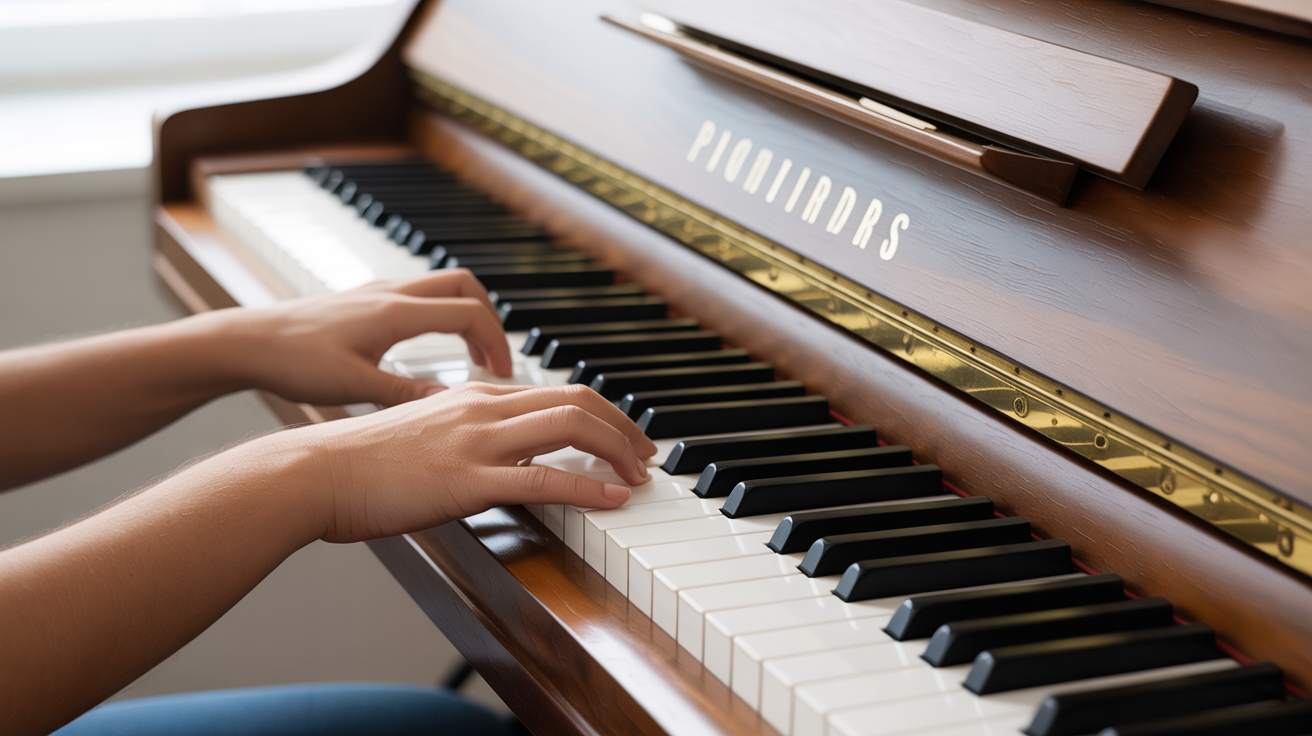
If you want to play real songs, learning piano chords for beginners is the fastest route there. Three chords (C major, F major, and G major) appear in hundreds of songs across pop, folk, gospel, and country. Get those three under your fingers and you can already play something that sounds like music, not just exercises.
This guide covers what a chord is, how to build the three most common beginner chords, where to put your fingers, and how to actually switch between them. No theory detours. Just the stuff you need to start playing.
At a Glance
- C, F, and G major cover the I-IV-V progression, the backbone of hundreds of pop, folk, and country songs.
- Every major chord is built the same way: root, then a note 4 half-steps up, then a note 3 half-steps above that.
- All three beginner chords use the same right-hand fingering: thumb (1), middle finger (3), pinky (5).
- Minor chords are one note different from major: lower the middle note (the third) by one half-step.
- Practice chord switches in slow motion first, pausing between each, before adding tempo or a metronome.
- A lead sheet shows only chord symbols above the lyrics, so once you know C, F, and G you can play along with most simple songs.
What a chord is (and why it matters)
A chord is three or more notes played at the same time. The most common type is a triad: three notes stacked in a specific pattern. On the piano, you play a triad by pressing three keys at once, usually one finger per key.
Chords give music its emotional quality. A major chord sounds bright and resolved. A minor chord sounds darker or more melancholy. Right now, focus on major chords. They're the ones beginners reach for first, and they're built from a simple formula.
How major chords are built
Every major chord uses the root, the major third, and the perfect fifth. Formally, a major chord is defined as a triad with a major third and a perfect fifth above the root. Those names sound technical, but here's the practical version: to build any major chord, start on any note, skip 3 half-steps (black or white keys), land on a note, then skip 3 more half-steps, and land again. That three-note stack is your major triad in root position.
Root position means the lowest note is the root, the note the chord is named after. When the third or fifth of a chord sits in the bass instead of the root, that rearrangement is called an inversion — the notes are the same, only the order changes, and the chord keeps its name either way. C major in root position has C on the bottom, E in the middle, and G on top. You'll sometimes see chords written in other positions, but start with root position. It's the most stable and the easiest to learn first.
If you want to dig deeper into how these shapes work across the keyboard, building major and minor triads on the piano walks through the formula key by key.
Worked example: counting half-steps to build C, F, and G major
Here's the formula applied to all three beginner chords, counted in actual half-steps on the keyboard:
| Chord | Root | +4 half-steps (major third) | +3 more half-steps (perfect fifth) | Result |
|---|---|---|---|---|
| C major | C | E | G | C - E - G |
| F major | F | A | C | F - A - C |
| G major | G | B | D | G - B - D |
Notice the math is identical every time: root, up 4 half-steps, up 3 more half-steps. Once that count is automatic, you can build a major chord starting on any key, white or black, without needing to memorize a separate shape for each one.
The three chords to learn first: C, F, and G major
These three chords go together because they all belong to the key of C major. That means they share the same set of notes (no sharps or flats), and they sound natural together. Musically, they're labeled with Roman numerals: C is I, F is IV, G is V. The I-IV-V is the most common chord sequence in Western music.
Here's what each chord looks like in root position:
| Chord | Notes | Right-hand fingers |
|---|---|---|
| C major | C – E – G | 1 – 3 – 5 |
| F major | F – A – C | 1 – 3 – 5 |
| G major | G – B – D | 1 – 3 – 5 |
Finger numbers: thumb = 1, index = 2, middle = 3, ring = 4, pinky = 5.
Notice that all three use fingers 1, 3, and 5. That's not a coincidence. It's the standard fingering for a root-position triad in one hand, and it works because it spaces your fingers evenly across the three notes.
How to play each chord
C major
Find middle C (the C nearest the middle of the keyboard). Place your right-hand thumb (finger 1) on that C. Without moving your thumb, let your middle finger (3) land on E and your pinky (5) on G. Press all three at once. That's C major.
Your hand should feel relaxed. Fingers should be slightly curved, like you're holding a tennis ball loosely. If any finger feels strained, you're pressing too hard. Keys need very little force.
F major
Move your thumb down to the F below middle C. Finger 1 on F, finger 3 on A, finger 5 on C. Press together. F major.
F is where some beginners stumble because the chord spans a wider stretch than C does. If your hand is small, the distance from F to C (a fifth) can feel like a reach at first. Don't force it. Let your wrist rotate slightly outward if needed. Stretching will come naturally with a few weeks of practice.
G major
Thumb on G (one white key to the right of F, or five white keys to the right of middle C), finger 3 on B, finger 5 on D. Press together. G major.
G major tends to feel the most natural of the three for right-handed players because it sits in a comfortable mid-register position.
Switching between chords
Playing each chord individually is one thing. Moving between them smoothly is what actually makes music. The transition is what trips most beginners up, not the shapes themselves.
A few things that help:
Look ahead, not at the chord you're playing. While you're holding C major, your eyes should already be scanning where your hand needs to move next. This sounds obvious, but most beginners stare at their current hand position.
Lift and land as one motion. When you move from C to F, lift your hand slightly and move it as a unit rather than dragging individual fingers. Think of it as relocating your whole hand shape, not rearranging fingers one at a time.
Practice the switch in slow motion first. Go from C to F and hold. Go from F to G and hold. Go from G back to C and hold. Pause between each chord until you can land cleanly every time, then gradually remove the pause.
Count out loud. Play C major for 4 beats, then F for 4 beats, then G for 4 beats, then C again. A slow, steady pulse (roughly one beat per second) is better than rushing. Speed comes after accuracy, not before.
Once the right hand feels stable, you can add a simple left-hand note: just play the root of each chord with your left-hand pinky (finger 5). Left-hand C while the right plays C major, left-hand F while the right plays F major, and so on. That one bass note makes the whole thing sound much fuller.
Reading chord symbols
Songs rarely write out "C major triad in root position." They use shorthand. Here's what you'll see:
- C = C major
- Cm = C minor
- F = F major
- G = G major
- G7 = G dominant seventh (a G chord with one extra note, common in blues and folk)
A chart that shows you just the chord symbols above the lyrics is called a lead sheet. Once you know your basic chords, lead sheets let you play along with almost any song. How to read chord symbols and lead sheets covers the full notation system, including seventh chords and slash chords.
Minor chords: a quick look
Once C, F, and G feel comfortable, add their minor versions. Minor chords use the same root and fifth but lower the middle note (the third) by one half-step, one key to the left.
| Chord | Notes | Right-hand fingers |
|---|---|---|
| C minor | C – E♭ – G | 1 – 3 – 5 |
| A minor | A – C – E | 1 – 3 – 5 |
| D minor | D – F – A | 1 – 3 – 5 |
A minor, D minor, and C major together give you a minor key feel that works for slower, more somber songs. Many beginner songs in a minor key use just Am, Dm, and G. E minor is also common but introduces a black-key stretch, so save it for later.
Notice that C minor uses E-flat, the black key between D and E. That one black key is what separates a major chord from its minor version. You can hear the difference clearly if you play C major and then C minor back to back.
Putting it together: a simple practice routine
Here's a 10-minute routine to build these chords from scratch:
- Play C, F, G each five times separately. Aim for clean, even tone.
- Switch C to F ten times slowly, pausing between chords.
- Switch F to G ten times slowly.
- Switch G back to C ten times slowly.
- Play the sequence C–F–G–C with 4 beats per chord, four times through.
- Add the left-hand root note and repeat the sequence twice.
Do this daily for a week and the chord shapes will start to feel automatic. Once they do, try playing along with a song you know, even just a familiar melody that sits in a comfortable key.
Common mistakes in the first weeks
A few patterns show up in almost every beginner's first month with chords, and knowing them ahead of time saves you weeks of confusion:
- Pressing too hard. New players often mash the keys out of nervousness about missing a note. A piano key only needs a few ounces of pressure to sound. If your forearm feels tired after a few minutes, you are overworking the motion.
- Resetting the hand shape every time. Instead of lifting the whole 1-3-5 shape as a unit between chords, some beginners release each finger separately and re-find the next chord note by note. That is slower and less reliable. Practice the "lift as one shape, land as one shape" motion deliberately, even in silence, away from the keyboard.
- Skipping the pause step. Rushing straight to tempo before the shapes are automatic just cements sloppy landings. The slow, paused version of the practice routine above is not a warm-up you get to skip; it is where the actual learning happens.
- Ignoring the left hand until chords feel "done." Adding a single left-hand root note early, even before your right hand is fully smooth, trains your hands to coordinate together from the start rather than bolting two separately-learned skills onto each other later.
Understanding which chords naturally follow each other is what takes you from shapes to songs. Common chord progressions every beginner should know covers the I–IV–V, the I–V–vi–IV (used in hundreds of pop songs), and a few others that come up constantly once you start playing real repertoire.
Frequently Asked Questions
Which chord should I learn first on piano?
Start with C major. It uses only white keys, the fingering (1–3–5) is straightforward, and it's the home chord for the most common beginner key. Once C feels natural, move to G major and then F major.
How long does it take to learn basic piano chords?
Most beginners can learn the shapes for C, F, and G major in one or two practice sessions. Switching between them cleanly without pausing usually takes one to two weeks of daily 10-minute practice. Speed varies depending on hand size and how much prior instrument experience you have.
Should I learn chords with my right hand or left hand first?
Right hand first, for most beginners. The right hand tends to play the melody and chords in simpler arrangements, so the shapes you're learning (C, F, G) are most immediately useful there. Left-hand chord voicings come later, once you're comfortable with two-handed coordination.
What is the difference between a major and a minor chord?
One note. In a major chord, the middle note (the third) sits four half-steps above the root. In a minor chord, it sits three half-steps above the root. That single half-step difference is what makes a major chord sound bright and a minor chord sound darker.
Do I need to memorize which fingers to use?
For root-position triads, the 1–3–5 fingering works across almost all three-note chords in the right hand. Learn that pattern once and it applies to every major and minor triad you play in root position. Chord inversions use different fingerings, but those come later.
Why do C, F, and G specifically work so well together?
They all belong to the key of C major, so none of them require a sharp or flat, and each one shares at least one note with its neighbor (C and F both contain C, F and G both sit a whole step apart with overlapping tension and release). That shared-note relationship is why the I-IV-V progression sounds so settled: your ear hears continuity between chords even as the harmony changes underneath it.