Reading Music
How to Read Notes on the Grand Staff (Lines and Spaces)
Learn to read notes on the grand staff using the lines-and-spaces mnemonics pianists actually use. Clear breakdown of treble, bass, and ledger lines.
Piano sheet music looks intimidating until you understand its structure. Notes on the grand staff are arranged on a grid of lines and spaces, and once you know four simple mnemonics, you can decode the position of any note on the page. This guide walks through that system from scratch.
What the grand staff actually is
Piano music uses two five-line staves stacked on top of each other. Together they form the grand staff.
The upper staff is the treble clef, also called the G-clef because its curling symbol wraps around the second line from the bottom to mark it as G4 (the G above middle C). Your right hand plays most of its notes here.
The lower staff is the bass clef, also called the F-clef because two dots bracket the fourth line from the bottom, marking it as F3. Your left hand mostly lives here.
Between the two staves sits a gap. Middle C (the C in the middle of the piano keyboard, also written C4) lives in that gap, sitting on a short line called a ledger line that floats between the staves. It belongs to both clefs, which is why it has its own dedicated position rather than belonging exclusively to either staff.
If you want a deeper look at how the two clefs relate to each other, this breakdown of the treble and bass clef for pianists covers the clef symbols and their history in more detail.
The five lines and four spaces in each clef
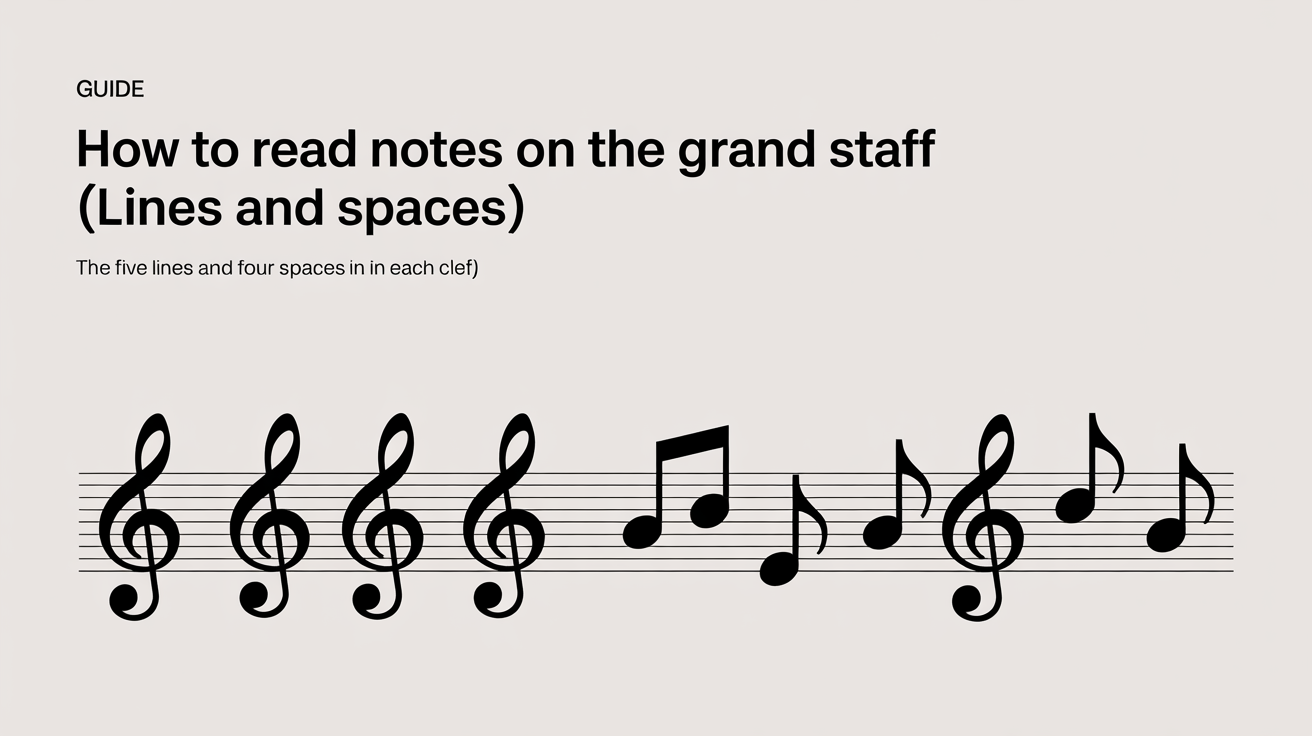
Each staff has five horizontal lines, numbered 1 (bottom) through 5 (top). Between each pair of adjacent lines is a space, giving you four spaces per staff. Notes can sit on a line (the line runs through the note head) or in a space (the note head floats between two lines).
That gives you nine positions per clef (five lines and four spaces) before you need ledger lines for notes higher or lower than the staff can hold.
The positions have fixed letter names (A through G, cycling), and the mnemonics below are simply memory shortcuts for those names.
Treble clef: the lines and spaces
The five lines (bottom to top): Every Good Boy Does Fine
- Line 1 (bottom): E4
- Line 2: G4
- Line 3: B4
- Line 4: D5
- Line 5 (top): F5
The sentence Every Good Boy Does Fine gives you E, G, B, D, F in order. Some teachers use "Every Good Boy Deserves Fudge" instead. Any version works as long as you remember the five letters.
The four spaces (bottom to top): FACE
- Space 1 (bottom): F4
- Space 2: A4
- Space 3: C5
- Space 4 (top): E5
The spaces spell FACE, which is easy to remember because it's an actual word. F-A-C-E, bottom to top.
Bass clef: the lines and spaces
The five lines (bottom to top): Good Boys Do Fine Always
- Line 1 (bottom): G2
- Line 2: B2
- Line 3: D3
- Line 4: F3
- Line 5 (top): A3
The sentence Good Boys Do Fine Always gives you G, B, D, F, A. Some teachers use "Great Big Dogs Fight Always" instead: same letters, different sentence. Pick whichever sticks.
The four spaces (bottom to top): All Cows Eat Grass
- Space 1 (bottom): A2
- Space 2: C3
- Space 3: E3
- Space 4 (top): G3
All Cows Eat Grass gives you A, C, E, G. Again, it's the actual letters that matter; the sentence is just a hook.
Quick reference table
| Staff | Position | Mnemonic | Notes (bottom to top) |
|---|---|---|---|
| Treble | Lines | Every Good Boy Does Fine | E4, G4, B4, D5, F5 |
| Treble | Spaces | FACE | F4, A4, C5, E5 |
| Bass | Lines | Good Boys Do Fine Always | G2, B2, D3, F3, A3 |
| Bass | Spaces | All Cows Eat Grass | A2, C3, E3, G3 |
A few things worth noticing in this table. First, the treble spaces (F4, A4, C5, E5) interleave exactly with the treble lines (E4, G4, B4, D5, F5): the whole staff is just the musical alphabet stepping up one letter at a time. Second, middle C (C4) doesn't appear in either column, because it sits on the ledger line between the staves, not on any of the ten regular positions.
Ledger lines: going beyond the staff
When a note is too high for the treble clef or too low for the bass clef, composers add short extra lines called ledger lines. The note sits on or between these lines just like the regular staff lines.
Middle C is the most common ledger line note pianists encounter. On the treble clef, it sits one ledger line below the bottom line (one step below E4). On the bass clef, it sits one ledger line above the top line (one step above A3). Both notations refer to the same key.
Reading ledger lines is really just an extension of counting. If the top treble line is F5, the space above it is G5, the first ledger line above is A5, and so on. The alphabet keeps going.
For a full treatment of note lengths and how rhythm works alongside pitch, note values and rhythm is a natural next step once the staff positions feel solid.
Putting it together at the piano
The mnemonics only help if you connect them to actual keys. Here's a short drill:
- Find middle C on your keyboard (it's the C closest to the middle, usually just left of the piano's brand name).
- Play G4 (five white keys above middle C) and say "line 2, treble, Good Boy."
- Play F4 (four white keys above middle C) and say "space 1, treble, FACE bottom."
- Do the same for two bass clef notes: G2 and A2.
Repeating this, touching the key while naming both its keyboard position and its staff position, builds the connection faster than staring at a chart alone. Most beginners find that the treble clef clicks first, then the bass clef takes another week or two of regular practice.
The beginner's guide to reading sheet music for piano covers how to combine note reading with rhythm and dynamics once you're comfortable with the lines and spaces.
Frequently Asked Questions
Do I really need to memorize all four mnemonics?
You need all four to read both clefs fluently. That said, most beginners anchor on the treble clef first (Every Good Boy Does Fine / FACE), then add the bass clef mnemonics a few weeks later. If you're only playing melodies with your right hand right now, starting with just the treble clef is practical.
Why does middle C have its own ledger line instead of belonging to one clef?
Middle C sits between the staves because grand staff notation was designed to minimize ledger lines. If middle C lived at the bottom of the treble staff, bass clef notes in the middle range would need multiple ledger lines above the bass staff, cluttering the score. The gap keeps both hands' most common ranges readable within their own five-line staves.
How do I tell whether a note is on a line or in a space?
Look at where the oval note head sits. If the line runs through the middle of the oval, the note is on that line. If the oval floats between two lines with no line touching it, it's in that space. With printed music this is usually obvious; with handwritten music it can be trickier, so when in doubt, count up from the bottom line of the staff.
What if I forget a mnemonic mid-practice?
Count from a landmark you know. In the treble clef, the second line is G4 (the clef symbol tells you this). From G4, just step up or down by letter: G, A, B, C, D... In the bass clef, the fourth line is F3. Count from there. Landmarks plus counting get you anywhere on the staff without needing to recall the full mnemonic sentence.
Do mnemonics change in different countries or teaching methods?
The letters never change; staff positions are standardized worldwide. The sentences do vary. British students sometimes learn "Every Good Boy Deserves Favour." Some teachers invent custom sentences with their students. As long as the first letter of each word matches E-G-B-D-F (treble lines) or G-B-D-F-A (bass lines), any sentence works. The mnemonic is a scaffold you eventually discard once the note names feel automatic.