Reading Music
How to Read Sheet Music for Piano: A Beginner's Guide
Learn how to read piano sheet music step by step. This beginner's guide covers the staff, clefs, note names, and rhythm basics with clear examples.
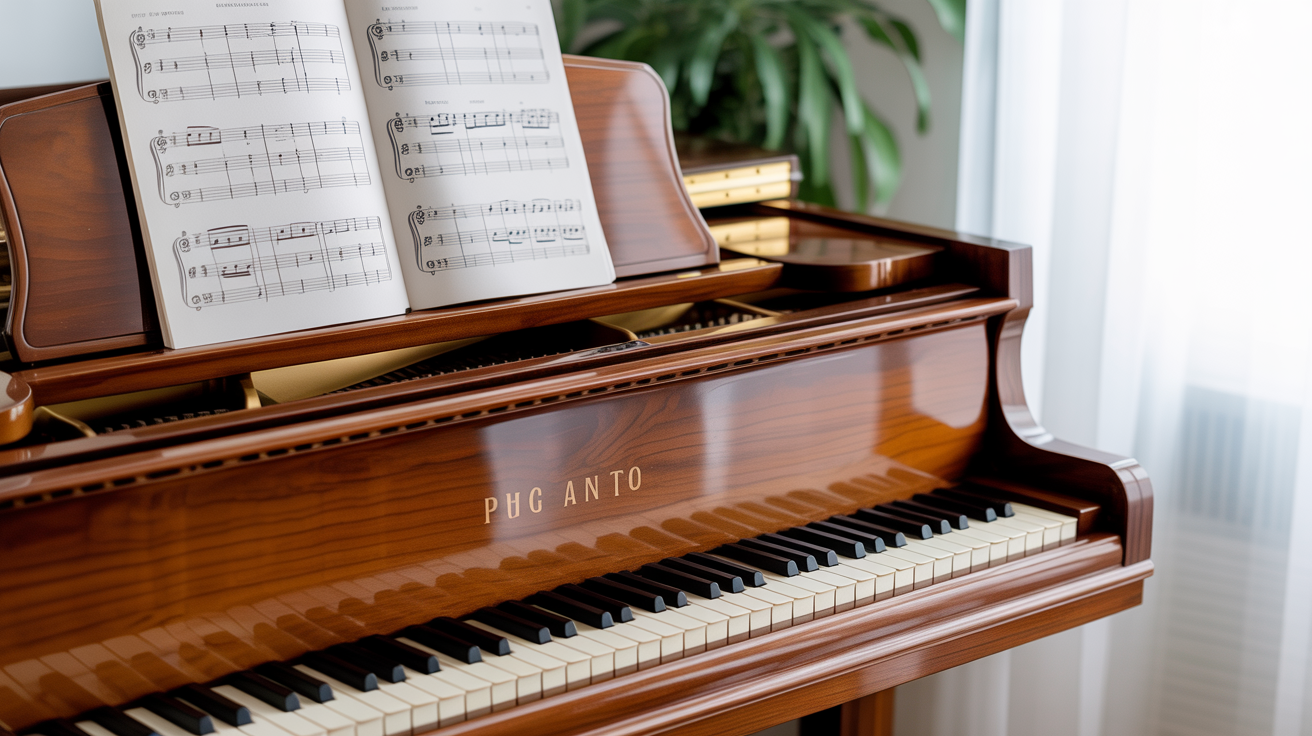
If you've ever sat down at a piano and stared at a page of sheet music wondering where to start, you're in good company. Learning how to read piano sheet music feels overwhelming at first, but the system behind it is genuinely logical. Once you understand the structure, you stop seeing a jumble of dots and lines and start seeing a map.
This guide covers the core ideas: what the staff is, how the two clefs divide the keyboard, where note names come from, and how rhythm notation works. By the end, you'll be able to look at a simple piece of sheet music and identify the correct keys.
What is sheet music, and why does piano use two staves?
Sheet music is a written record of musical sound. Each note on paper corresponds to a specific pitch (how high or low the sound is) and a specific duration (how long it lasts). Composers have used this system for several hundred years, and it's stable enough that a piece from 1750 and one written last year use the same basic notation.
Piano is unusual among instruments because players use both hands across a wide range of pitches simultaneously. To accommodate this, piano music is written on a grand staff: two sets of five horizontal lines stacked vertically, connected by a brace on the left side.
The top staff generally handles the right hand and the bottom staff handles the left. Each staff has its own clef, which tells you which pitches those five lines and the spaces between them represent.
The treble clef and bass clef
The treble clef sits at the start of the top staff. It's the curly symbol that wraps around the second line from the bottom. That line is G4, the G above middle C. Everything is built outward from that anchor point.
The bass clef sits at the start of the bottom staff. It looks like a backward C with two dots. Those two dots bracket the fourth line from the bottom, which is F3, the F below middle C. Everything on the bass staff is built from that anchor.
For a full breakdown of how each clef works and how to learn its note positions, see The treble clef and bass clef explained for pianists.
The staff: lines, spaces, and note names
Each staff has five lines and four spaces. Notes sit either on a line (the line passes through the center of the note head) or in a space (the note head sits between two lines). The pitch goes up as you move up the staff.
The note names in Western music are seven letters that repeat: A B C D E F G, then back to A. When you reach A again, you're at a higher octave: the same note name, but twice the frequency.
Notes on the treble clef
| Position | Note |
|---|---|
| Bottom line | E4 |
| Bottom space | F4 |
| Second line | G4 |
| Second space | A4 |
| Middle line | B4 |
| Third space | C5 |
| Fourth line | D5 |
| Fourth space | E5 |
| Top line | F5 |
A common memory aid for the treble clef lines: Every Good Boy Does Fine. For the spaces, they spell FACE from bottom to top.
Notes on the bass clef
| Position | Note |
|---|---|
| Bottom line | G2 |
| Bottom space | A2 |
| Second line | B2 |
| Second space | C3 |
| Middle line | D3 |
| Third space | E3 |
| Fourth line | F3 |
| Fourth space | G3 |
| Top line | A3 |
Memory aids for bass clef lines: Good Boys Do Fine Always. Spaces spell All Cows Eat Grass.
These mnemonics are worth memorizing early, but after a few weeks of practice you'll start recognizing note positions directly without running through the sentence each time.
For a detailed look at how both staves fit together and how to read notes across the full range of the piano, see How to read notes on the grand staff: lines and spaces.
Middle C and how it connects the two staves
Middle C is the C closest to the middle of a standard 88-key piano (it's the fourth C from the left). On sheet music, middle C sits on a short line called a ledger line that floats below the treble staff or above the bass staff. That ledger line is not part of either staff; it's a temporary extension.
When middle C appears in the treble staff, the ledger line is one step below the bottom line. When it appears in the bass staff, the ledger line is one step above the top line. Both mean the same note: same key on the piano, same pitch.
This is why the two staves connect at middle C. The treble staff handles roughly the upper half of the keyboard; the bass staff handles the lower half. Middle C is the handoff point, though in practice both hands sometimes cross that line depending on what the music requires.
Ledger lines: going beyond the staff
Notes don't stop at the top or bottom of a staff. When a pitch falls outside the five-line range, ledger lines extend the staff temporarily.
A note on one ledger line above the treble staff is G5. Two ledger lines above is C6. The same principle applies going down: one ledger line below the bass staff is E2. Ledger lines follow the same spacing as the regular staff lines.
Ledger lines are one reason beginners sometimes find sheet music intimidating. A cluster of them looks complicated. The trick is to count carefully from a known anchor rather than trying to memorize every position. Find a line or space you recognize, then step up or down from there.
Reading rhythm: note values
Pitch tells you which key to press. Rhythm tells you how long to hold it. The two pieces of information come from the same symbol: the note head (the oval shape) combined with a stem, flag, or beam.
Here are the four most common note values and how they relate:
| Symbol | Name | Duration (beats) |
|---|---|---|
| Open oval, no stem | Whole note | 4 |
| Open oval with stem | Half note | 2 |
| Filled oval with stem | Quarter note | 1 |
| Filled oval with stem + flag | Eighth note | 1/2 |
These values are relative, not absolute. The actual speed depends on the tempo marking at the top of the piece. But the relationships stay constant: a half note is always twice as long as a quarter note.
A dot placed after a note head increases its duration by half. A dotted half note lasts three beats instead of two. A dotted quarter note lasts one and a half beats.
For a thorough guide to rhythm notation and how to count beats at the piano, see Note values and rhythm: whole, half, and quarter notes.
Time signatures and measures
Sheet music is divided into small sections called measures (also called bars) by vertical lines called bar lines. A measure groups a fixed number of beats together.
At the start of a piece, after the clef, you'll see a time signature: two numbers stacked, like 4/4 or 3/4.
- The top number tells you how many beats are in each measure.
- The bottom number tells you what kind of note gets one beat. A 4 on the bottom means the quarter note gets one beat.
So 4/4 means four beats per measure, quarter note gets one beat. This is the most common time signature and is sometimes called "common time." 3/4 means three beats per measure, which is the rhythm of a waltz.
When you're learning a new piece, tap the beat before you play. Count "1, 2, 3, 4" aloud at a steady tempo, then start matching notes to beats. Slow and steady is the right approach; the goal is accuracy, not speed.
Putting it together: how to approach a new piece
When you open a piece of sheet music for the first time:
- Look at the clef and time signature before touching the keys.
- Find the key signature (the sharps or flats immediately after the clef). These tell you which notes are altered throughout the piece.
- Identify the tempo marking. These are usually Italian words: Andante (walking pace), Moderato (moderate), Allegro (fast).
- Scan the note range. Are there ledger lines to decode? Identify those pitches before playing.
- Practice hands separately. Read the treble staff with your right hand, then the bass staff with your left, before combining them.
- Count aloud as you play. Even experienced sight-readers do this with unfamiliar rhythms.
Reading piano sheet music is a skill that builds over time, not a switch you flip. The first few weeks feel slow. Then one day you look at a measure and just know the notes without working them out letter by letter.
Frequently Asked Questions
How long does it take to learn to read piano sheet music?
Most beginners can read simple melodies in treble clef within four to six weeks of regular practice. Reading both staves simultaneously takes longer, often several months. The pace depends heavily on how consistently you practice and whether you have feedback from a teacher or structured method book.
Do I need to learn to read sheet music, or can I just learn by ear?
Playing by ear is a genuine skill and many excellent musicians do it. But sheet music unlocks a much larger library of music, lets you learn pieces accurately without recordings, and makes it easier to communicate with other musicians. Most piano learners benefit from knowing both.
What's the difference between reading music and music theory?
Reading music is the skill of translating notation into sound on your instrument. Music theory is the study of why music works the way it does: harmony, scales, chord construction, form. They overlap, but you can learn to read music quite well without a deep background in theory.
What does the key signature mean?
A key signature is a group of sharps (#) or flats (b) placed after the clef at the start of each line. It tells you which notes are raised or lowered throughout the piece, so the composer doesn't have to write an accidental (a sharp or flat next to the note) every single time. If you see two sharps in the key signature, every F and C in the piece is played as F-sharp and C-sharp unless otherwise marked.
I can read each note slowly but I can't play both hands together. What helps?
This is the most common sticking point. Practice each hand separately until each one is comfortable at tempo, then try hands together at a much slower speed than you think is necessary. Many method books recommend the "70% rule": if you can play both hands together cleanly at 70% of your target tempo, you're ready to gradually speed up. Rushing the process usually means drilling mistakes into muscle memory, which takes longer to undo than slowing down would have.