Technique & Hands
Beginner Piano Scales: Which to Learn First and Why
Learn which piano scales to tackle first, in what order, and exactly how they train your hands — starting with C major and building from there.
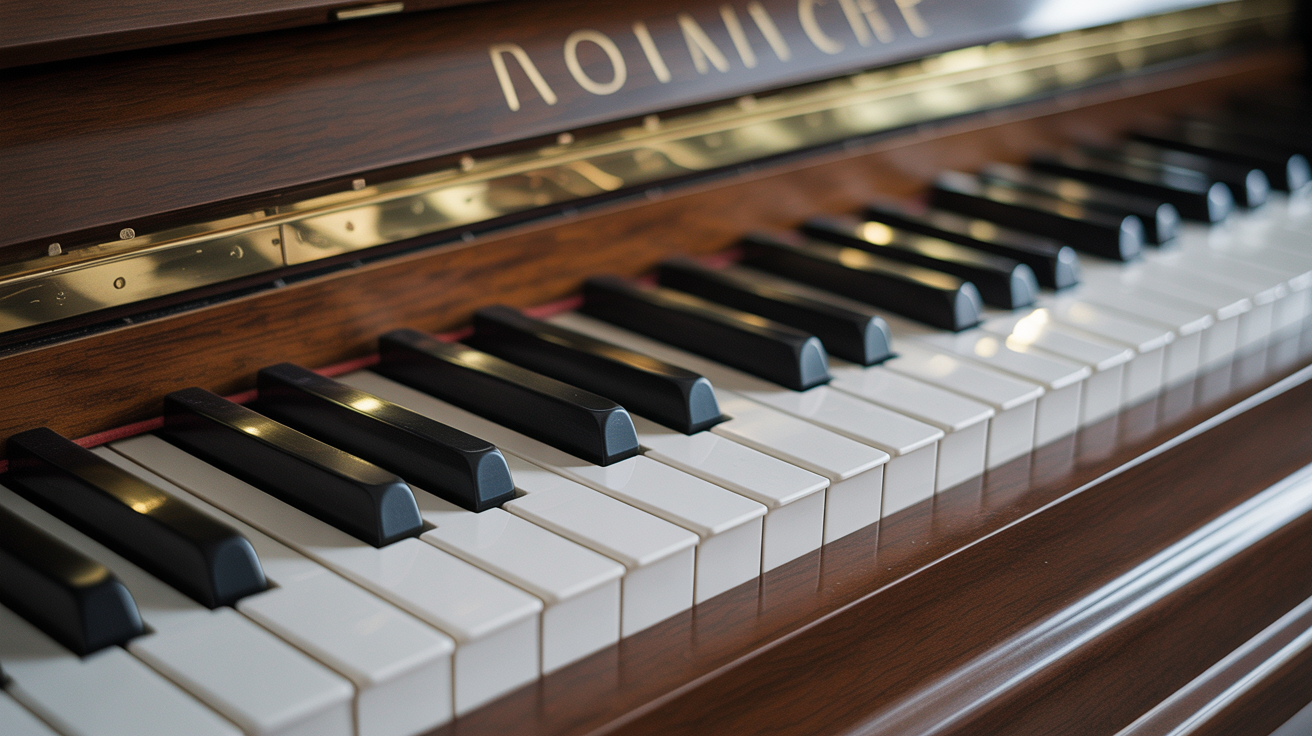
If you've just started playing piano, you've probably heard that scales are important, but nobody seems to explain which piano scales for beginners actually matter, or why you'd bother with them at all. Here's the short answer: scales teach your fingers where the notes live, build even strength across all five fingers, and train your hands to move as a unit. The longer answer involves a specific order that makes each new scale easier than the last.
Why C major comes first
C major is the only major scale played entirely on white keys. No sharps, no flats, just seven consecutive white notes from C to C. That simplicity isn't a coincidence. It lets you focus on two things that matter more than note names right now: correct finger numbers and hand position, and the physical feeling of passing your thumb under your fingers (and your fingers over your thumb) smoothly.
Every major scale follows the same pattern of whole steps and half steps:
W – W – H – W – W – W – H
A whole step skips one key (white or black). A half step moves to the very next key with nothing in between. On the piano, E–F and B–C are the only pairs of white keys that are a half step apart, with no black key between them. The C major scale lands its two half steps exactly on those pairs: E to F (steps 3–4) and B to C (steps 7–8). You can feel that pattern in your hand before you even think about it consciously.
If you want a detailed walkthrough of the fingering, this guide to playing the C major scale with the right fingering covers the thumb crossover moment step by step.
The sensible order after C major
Once C major feels steady (meaning you can play it hands separately at a comfortable tempo without looking down), move to G major and F major next, in either order. Then add A minor. Here's why that sequence works:
| Scale | New challenge added | Sharps / Flats |
|---|---|---|
| C major | Thumb crossover, even finger pressure | None |
| G major | One black key (F#), same fingering pattern | 1 sharp (F#) |
| F major | One black key (Bb), thumb placement shifts | 1 flat (Bb) |
| A minor (natural) | Minor sound, same white-key pattern as C | None |
| D major | Two black keys, hand moves slightly right | 2 sharps (F#, C#) |
| E minor | Relative of G major, shares 1 sharp | 1 sharp (F#) |
| Bb major | Two flats, hand stays mostly on black keys | 2 flats (Bb, Eb) |
G major adds exactly one black key (F#) in a spot where the fingering barely changes. F major also adds one black key (Bb), but it falls under finger 4 in the right hand, which is worth practicing because that finger tends to be the weakest. After two major scales with one accidental each, your brain starts to internalize the W–W–H–W–W–W–H pattern rather than memorizing each scale separately.
A natural minor scale uses the same notes as its relative major but starts on a different root. A minor shares all its notes with C major (no sharps or flats), so the finger pattern is already familiar. What changes is the sound: minor scales have a half step between steps 2 and 3, rather than steps 3 and 4, which gives them that darker color. Playing A minor right after C major makes that contrast obvious in a way that's hard to forget.
What scales actually do for your hands
This is the part teachers sometimes skip. Scales aren't just a list of notes; they're a physical training circuit.
Even finger pressure. Most beginners have a loud index finger and a quiet ring finger. Playing scales slowly, listening for each note to match the others in volume, forces you to notice and correct that imbalance. Your ears become the teacher here.
Thumb crossover. The right-hand C major scale assigns fingers 1–2–3, then the thumb tucks under to land on F, and fingers 1–2–3–4–5 finish the octave. That pivot is the single most important technical skill in major scales piano work. It needs to be invisible: no bumps, no accent on the thumb note.
Hands together. The left hand plays the same scale but with mirrored fingering: 5–4–3–2–1, then 3–2–1 to finish. When both hands play together, the thumbs cross at different moments, which feels strange at first. The fix is to practice hands separately until each hand is automatic, then combine them at a slow tempo. That process is exactly what playing with both hands together for the first time walks through.
Speed over time. Start every scale session at a tempo where you make zero mistakes. Genuinely zero. Slow practice at high accuracy builds the muscle memory that lets you speed up later. Fast practice with errors just rehearses the mistakes.
How to practice scales without losing your mind
A short daily session beats a long occasional one. Ten minutes of scales five days a week will move you further than forty-five minutes on Saturday.
One approach that works well for beginners:
- Pick one scale per week. Don't rotate through all of them daily until each one is solid.
- Play it hands separately first: right hand two octaves up and back, then left hand the same way.
- Play it hands together at half the tempo you used separately.
- If a specific spot keeps tripping you up (usually the thumb crossover), isolate those three or four notes and repeat them until the movement smooths out.
- End the session with a piece you enjoy. Scales are a warm-up, not the whole meal.
A metronome helps more than most beginners expect. Set it at a tempo where you feel slightly bored — that's probably the right speed. The goal is a steady, even sound across all eight notes.
When to move to the next scale
There's no rule about weeks or months. The signal to move on is simple: you can play the current scale hands together, two octaves, at a moderate tempo, without thinking about the fingering. If you still have to mentally remind yourself "thumb goes under here," stay with it a bit longer.
Don't skip scales just because they feel easy. G major with its one sharp will feel trivial, and that's the point. Easy success at G major builds the neural pathway that makes D major (two sharps) feel like a small adjustment rather than a new problem.
Frequently Asked Questions
Do I have to learn all 12 major scales?
Not right away. The first five or six in the order above (C, G, F, A minor, D, and E minor) cover the keys most beginner pieces are written in. The remaining scales (Ab, Db, Gb, B, and Eb major) involve more black keys and come up less often in early repertoire. Learn them eventually, but don't let them block you from playing actual music now.
Should I learn minor scales before or after major scales?
After. Natural minor scales are easier to understand once you know at least C major, because A minor shares the same notes. Harmonic and melodic minor (which raise certain scale degrees to change the sound's character) make more sense after natural minor is solid. Most beginners don't need harmonic or melodic minor for their first six to twelve months.
How long does it take to get a scale to feel smooth?
For C major, hands separately: a few days to a week of short daily sessions is typical. Hands together takes longer. Two to four weeks is common, sometimes more. Every person's hands are different, and the timeline shifts based on how much you practice each day. If a scale stays choppy after several weeks of regular work, the most likely cause is that you're practicing too fast.
Is it okay to skip scales and just learn songs?
You can learn songs without scales, and plenty of people do. The trade-off is that each new song takes longer to learn because your fingers don't have a map of the keyboard yet. Scales are the map. Once the map is in your hands, new songs feel like routes you already know half of.
What's the difference between a scale and an arpeggio?
A scale plays every note of a key in stepwise order (C–D–E–F–G–A–B–C). An arpeggio plays only the first, third, and fifth notes of the scale, jumping between them (C–E–G–C). Arpeggios are worth learning after you're comfortable with scales; they share the same fingering logic but train a wider hand span.