Technique & Hands
How to Play the C Major Scale with the Right Fingering
Learn c major scale piano fingering step by step: right-hand 1-2-3-1-2-3-4-5, left-hand 5-4-3-2-1-3-2-1, thumb-under technique explained.
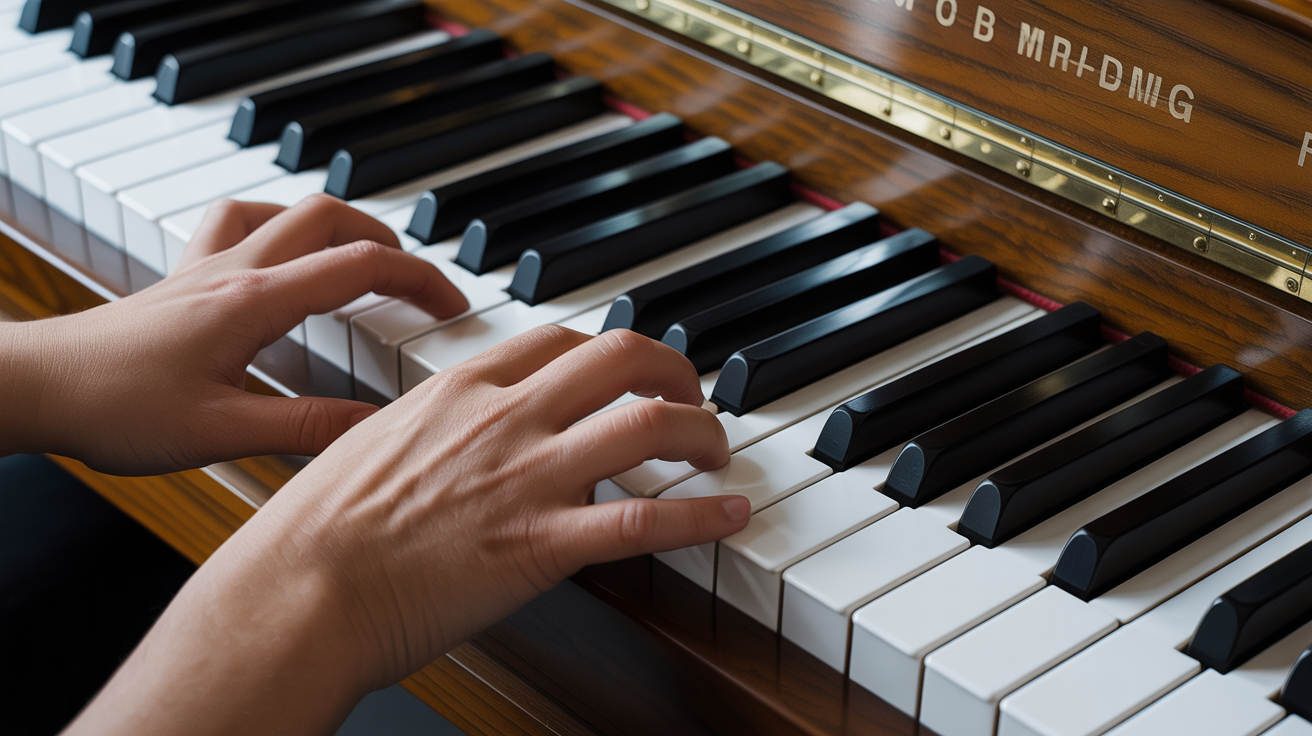
C major is the first scale almost every piano student learns, and for good reason: it uses only white keys, so you can see the shape clearly without any sharps or flats getting in the way. But the fingering trips up beginners more than the notes do. Get the fingering right from the start and the scale feels smooth; ignore it and you'll hit a wall the moment you try to play faster or add more scales.
This guide covers the correct c major scale piano fingering for both hands, explains the thumb-under move that makes it work, and gives you a practice sequence that actually builds the skill.
At a Glance
- The C major scale is C-D-E-F-G-A-B-C, all white keys, one octave.
- Right hand going up: 1-2-3-1-2-3-4-5. The thumb crosses under after finger 3 plays E.
- Left hand going up: 5-4-3-2-1-3-2-1. The crossing happens between G and A, not between E and F.
- Practice each hand alone first, and start hands-together at a much slower tempo than either hand can manage solo.
- A metronome exposes uneven timing at the crossing point faster than playing without one; start around 60 BPM.
- Short daily sessions beat one long weekend session for locking in the thumb-under motion.
The notes first: C D E F G A B C
Before fingering, know what you're playing. The C major scale runs across eight notes: C – D – E – F – G – A – B – C. On a standard keyboard, find middle C (the white key just to the left of a group of two black keys, roughly in the middle of the keyboard). From there, play every white key going up until you reach the next C. That's one octave.
There are no black keys in C major. That makes it easier to watch your fingers, which is exactly why it's the starting scale for beginners learning piano scales.
Finger numbers: a quick refresher
Pianists number the fingers 1 through 5 on each hand:
| Finger | Right hand | Left hand |
|---|---|---|
| 1 | Thumb | Thumb |
| 2 | Index | Index |
| 3 | Middle | Middle |
| 4 | Ring | Ring |
| 5 | Pinky | Pinky |
If this is new to you, spend a minute with piano finger numbers and correct fingering for beginners before continuing. The rest of this guide uses these numbers constantly.
Right-hand fingering: 1-2-3-1-2-3-4-5
The standard right-hand fingering for one octave going up is 1-2-3-1-2-3-4-5. Coming back down, reverse it: 5-4-3-2-1-3-2-1.
Here's how that maps onto each note:
| Note | Finger (going up) | Finger (coming down) |
|---|---|---|
| C | 1 (thumb) | 5 (pinky) |
| D | 2 (index) | 4 (ring) |
| E | 3 (middle) | 3 (middle) |
| F | 1 (thumb) | 2 (index) |
| G | 2 (index) | 1 (thumb) |
| A | 3 (middle) | 3 (middle) |
| B | 4 (ring) | 2 (index) |
| C | 5 (pinky) | 1 (thumb) |
The sequence breaks into two groups: fingers 1-2-3 cover C-D-E, then the thumb crosses under to land on F, and fingers 1-2-3-4-5 cover the rest. That crossing move is called the thumb-under technique, and it's what lets you play eight notes with only five fingers.
How the thumb-under works
Most students tense up at the crossing point, which creates a bump or hesitation in the sound. Here's what's actually happening: while finger 3 (middle) plays E, your thumb quietly swings under your palm and positions itself over F. By the time you lift finger 3, the thumb is already waiting on F. The two notes (E played by finger 3 and F played by thumb 1) should sound equally loud and equally timed with no gap.
Slow practice makes this obvious. Play C-D-E at a walking pace. After you press E with your middle finger, pause and notice where your thumb is. It should already be hovering over F, not still tucked in toward your palm. If it's not there yet, that's the habit to fix.
Coming down, the reverse crossing happens at E: while finger 2 plays F, finger 3 prepares to cross over the thumb and land on E. This "finger-over" is slightly easier than thumb-under for most people, but the principle is the same: the finger moves early, not late.
A common mistake worth naming directly: lifting the wrist to "help" the thumb cross. It doesn't help. Raising the wrist actually shortens the thumb's reach and makes the crossing later, not earlier. Keep the wrist level and let the forearm rotate slightly instead. That small rotation gives the thumb room without disturbing the hand's shape.
Left-hand fingering: 5-4-3-2-1-3-2-1
The left hand uses different numbers for the same notes. Going up: 5-4-3-2-1-3-2-1. Coming down: 1-2-3-1-2-3-4-5.
| Note | Finger (going up) | Finger (coming down) |
|---|---|---|
| C | 5 (pinky) | 1 (thumb) |
| D | 4 (ring) | 2 (index) |
| E | 3 (middle) | 3 (middle) |
| F | 2 (index) | 1 (thumb) |
| G | 1 (thumb) | 2 (index) |
| A | 3 (middle) | 3 (middle) |
| B | 2 (index) | 4 (ring) |
| C | 1 (thumb) | 5 (pinky) |
The left hand starts with its pinky (5) on C and works down through 5-4-3-2-1 until the thumb lands on G. Then finger 3 crosses over the thumb to reach A, and 3-2-1 finishes the octave. So the left hand's crossing point is between G and A, not between E and F like the right hand.
Keep your wrist level and relaxed through the crossing. A lot of beginners jerk the wrist sideways when the finger crosses over, and that telegraphs the move and breaks the evenness of the sound. Let the fingers do the work; the wrist stays relatively still.
It helps to notice that the two hands never cross at the same note. The right hand's crossing sits between E and F; the left hand's sits between G and A. That mismatch is exactly why hands-together practice feels harder than either hand alone: your brain has to track two different trouble spots instead of one.
Practicing each hand separately
Before combining hands, each hand needs time on its own. Rushing to hands-together before a hand is secure on its own is one of the most common reasons progress stalls.
A straightforward approach:
- Right hand alone, very slowly. Play C-D-E, pause, check your thumb is over F, then continue. Go up one octave and back. Repeat five times.
- Left hand alone, very slowly. Play C-D-E-F-G, pause, check finger 3 is ready to cross over to A, then continue. Go up one octave and back. Repeat five times.
- Increase speed gradually. Use a metronome if you have one. Start at 60 BPM, playing one note per beat. When you can play cleanly three times in a row at that speed, move up to 70 BPM. Don't chase speed; chase evenness.
One thing worth checking: all eight notes should sound the same volume. If the thumb notes (C, F in the right hand) sound quieter or heavier than the others, that's normal at first. The thumb is the least coordinated finger for most people. Consciously level it out.
A simple test for evenness: record yourself on a phone playing the scale up and down at a slow, steady tempo. Listen back with your eyes closed. Any note that jumps out, either louder or shorter than its neighbors, points to a finger that needs isolated attention. This is a faster way to catch problems than trying to judge your own playing in real time.
A practice tempo ladder
If you're not sure how fast to push things, here's a reasonable week-by-week target for one octave, hands separate, using a metronome at one note per beat:
| Session | Target tempo | What to check |
|---|---|---|
| Days 1-2 | 50-60 BPM | Thumb pre-positions before finger 3 lifts, no bump at the crossing |
| Days 3-4 | 65-75 BPM | All eight notes even in volume, wrist stays level |
| Days 5-7 | 80-90 BPM | Scale sounds smooth up and down without slowing at the crossing |
| Week 2 | 90-100 BPM | Hands together at roughly 60-70% of this tempo |
Treat these numbers as a guide, not a deadline. If you're not clean at one tempo, stay there. Moving up before a tempo is solid just teaches your hands to play the mistake faster.
Putting both hands together
Playing both hands together means managing two different crossing points at the same time: the right hand crosses thumb-under on F while the left hand crosses finger-over on A. They don't happen on the same note, which means your brain needs to track them independently.
The most effective approach is to learn hands-together at a much slower tempo than either hand can manage alone. If your right hand is comfortable at 80 BPM, start hands-together practice at 50 BPM. That gap feels frustrating but it's accurate. Combining hands is a separate skill, not just playing faster.
Go through the full sequence for playing with both hands together in how to play with both hands together for the first time, which covers the coordination mechanics in more depth.
A simple trick that helps: say the finger numbers out loud as you play. "1-2-3-1-2-3-4-5" for the right hand, "5-4-3-2-1-3-2-1" for the left. It sounds silly, but it keeps the two patterns from blurring together in your head, especially at the crossing points.
How long does it take?
There's no single answer. Some students nail the thumb-under in one session; others work on it for a week before it feels natural. The range is wide partly because hand size and finger independence vary, and partly because some people practice for 10 minutes a day while others sit at the keyboard for an hour.
What tends to predict success more than raw time is consistency. Ten minutes every day beats an hour on Sunday. This isn't just a piano-teacher saying: research on motor sequence learning has found that distributed practice, spaced out across separate sessions with rest between them, produces better skill acquisition and retention than the same total time compressed into one massed session. The motor coordination you're building (finger independence, thumb-under timing, even tone) develops through repetition spread over multiple days, not one long session, and your hands seem to consolidate the movement during the breaks as much as during the practice itself.
If something hurts, stop. Wrist strain and finger fatigue are signs that you're tensing rather than relaxing through the movement. Shake your hands out, check your seat height (forearms roughly parallel to the floor is a good starting point), and return with less force.
Frequently Asked Questions
Why does fingering matter? Can't I just use whatever fingers feel natural?
You can play the scale with random fingers, but you'll hit a ceiling quickly. The standard fingering for the C major scale is designed so that crossing and position shifts happen at the same points every time, which makes muscle memory possible. Consistent fingering is also why two players can sit at the same piano and play the same passage the same way; it's not arbitrary. The modern habit of using the thumb freely to cross under other fingers, rather than avoiding it, traces back to keyboard fingering innovations credited to J.S. Bach, which expanded what the thumb could do and made fast, even scale playing possible in the first place.
What if my thumb-under crossing makes a bump in the sound?
This is the most common problem. Usually it means one of two things: the thumb isn't moving early enough (it waits until finger 3 lifts, rather than moving while finger 3 is still down), or there's extra tension in the wrist during the crossing. Slow down to a pace where you can feel the thumb pre-positioning, and actively keep the wrist soft. The bump tends to disappear over a week of focused slow practice.
Should I look at my fingers or at the keys?
At this stage, looking is fine. C major uses only white keys with an obvious visual pattern, so you'll develop a feel for the distances faster than on a scale with black keys mixed in. Over time you'll start trusting your hands more and looking less, but there's no need to force eyes-closed playing now.
Do I have to use a metronome?
Not strictly required, but highly useful. A metronome makes it obvious when your speed is uneven, and it almost always is uneven at the crossing points early on. If you don't have a physical metronome, most piano apps and free browser tools include one. Set it slow and use it, at least for a few practice sessions.
Is the fingering the same for two octaves?
Yes. When you extend the C major scale to two octaves, the right hand continues the pattern: after reaching the octave C, continue up with 1-2-3-1-2-3-4-5 again. The thumb-under happens again on F (the F one octave above the starting point). The left hand mirrors this coming back down. Once the one-octave fingering is solid, two octaves follow naturally from the same pattern.
My hands are small. Do I need different fingering?
Standard fingering works for most hand sizes because the crossing points are chosen around where the black keys sit, not around a specific hand span. Very small hands sometimes benefit from practicing the crossing slightly earlier, moving the thumb under a fraction sooner, to compensate for a shorter reach. If a stretch feels genuinely painful rather than just unfamiliar, that's worth mentioning to a teacher rather than pushing through it.