Practice & Progress
How to Build a Daily Piano Practice Routine That Works
A practical piano practice routine for beginners: what to do, in what order, and how long each part takes so you actually improve.
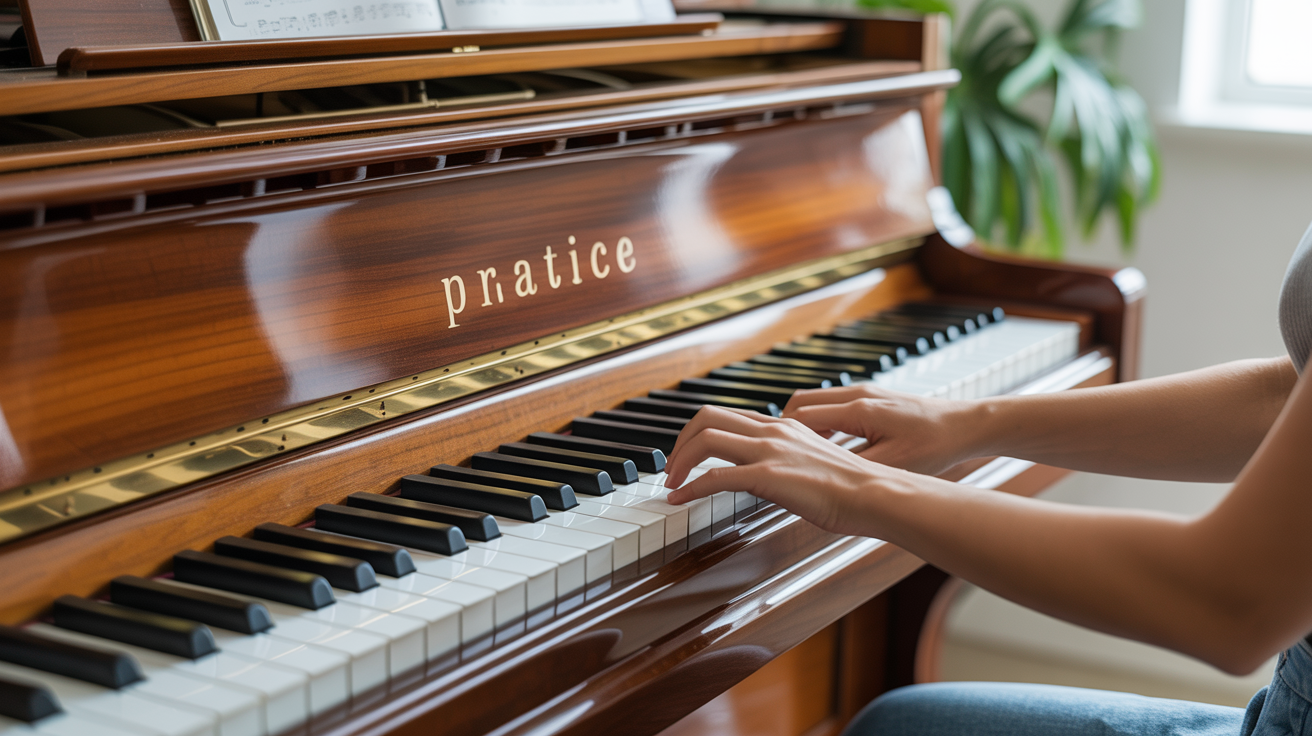
A piano practice routine for beginners doesn't need to be complicated. It needs to be consistent. Thirty minutes a day, done well and in the right order, will get you further than a two-hour session crammed in once a week. This guide breaks down exactly what to do each day, how long to spend on each part, and why the order matters.
Why structure beats willpower
Sitting down at the piano without a plan usually means you drift toward what's comfortable. You play the piece you already know, maybe noodle around for a bit, and then close the lid. Nothing wrong with that, but it's not practice. It's playing.
Practice means working on the things that are slightly harder than you can do right now. That's uncomfortable, and without a plan, your brain will steer you away from it every time. A routine removes the decision. You sit down, you do the thing that comes first, then the next thing. You don't have to summon motivation because you're not making any choices.
What goes into a beginner practice session
There are four parts to a good session: a physical warm-up, technique work, repertoire (the pieces you're learning), and a brief cool-down where you play something just for fun. Each part serves a different purpose, and the order isn't arbitrary.
Physical warm-up (5 minutes)
Before you play any notes, spend a minute or two doing hand and wrist stretches away from the keyboard. Spread your fingers wide, make a gentle fist, rotate your wrists slowly in both directions. Piano playing is repetitive motion, and cold hands are more prone to strain.
Then sit at the piano and play a few minutes of very slow, even notes. The five-finger exercise is the standard: starting with your thumb on middle C, play C-D-E-F-G and back, one note per beat, both hands separately. Keep the tempo slow enough that every finger lifts and falls with the same weight. The goal here is blood flow and a settled feeling, not musical achievement.
Technique work (8–10 minutes)
Technique is the mechanical skill underneath everything else: how your fingers move, how you handle scales, how you coordinate both hands. Most beginners skip this and pay for it later.
For the first month or two, use this time on:
- Scales: C major is the starting point (all white keys, no sharps or flats). Play it one octave up and back with your right hand, then your left, then together. Keep each note the same volume.
- Hands-separately practice: Take a short passage from whatever you're learning and play it with just the right hand until it's smooth, then just the left. Putting hands together before each hand knows its part doubles the difficulty for no reason.
- Finger independence: The fourth and fifth fingers (ring and pinky) are naturally weaker. A simple drill: hold fingers 1, 2, 3 down on three keys and tap fingers 4 and 5 independently. Do this on both hands.
Using a metronome during technique work is worth the initial awkwardness. It gives you honest feedback about whether your notes are actually even. How to use a metronome to improve your timing explains the setup if you haven't tried one yet.
Repertoire (12–15 minutes)
This is where you work on your actual pieces. "Work on" means something specific: you find the parts that don't go smoothly and practice those, not the parts that already feel good.
A practical method:
- Play through the piece once at a slow tempo to identify the rough spots.
- Isolate one problem passage (maybe four bars where your left hand isn't reliable).
- Practice that passage hands-separately, then hands-together, at a tempo where you can play every note correctly.
- Gradually increase the tempo using a metronome, adding just 5–10 BPM at a time.
- Return to the full piece and see whether that passage has improved.
The instinct is to start from the beginning every time. Resist it. The beginning always sounds fine (you've played it most) and the problem spots stay rough.
If you're working on more than one piece, split the repertoire time between them. New learners should usually keep two pieces active at once: one that's genuinely challenging and one that's almost performance-ready.
Cool-down (3–5 minutes)
End every session by playing something you enjoy that doesn't require effort. This might be a piece you finished last month, a simple melody you know by heart, or just improvising around a few chords. The purpose is to send yourself away from the piano feeling good rather than frustrated. It also reinforces that piano isn't only a discipline. It's something you wanted to do in the first place.
A sample 20-minute practice block
Not everyone has 30 minutes every day. Here's how to compress without losing the structure:
| Segment | Time | What to do |
|---|---|---|
| Warm-up | 3 min | Hand stretches + slow five-finger exercise on C |
| Technique | 5 min | C major scale, one octave, hands separately then together |
| Repertoire | 10 min | Identify one rough passage, drill it hands-separately, then together |
| Cool-down | 2 min | Play through a piece you already know |
Twenty minutes practiced this way is more productive than an hour of unfocused run-throughs.
How to handle days when practice feels pointless
Every beginner hits a week where nothing seems to improve. The piece sounds the same as last Tuesday. Your hands feel clumsy. This is normal, and it's not a signal to practice more. It's usually a signal that your brain needs to consolidate what it's learned.
Two things that help: lower the difficulty temporarily (slow the metronome down until everything feels easy, then rebuild), and zoom out on your timeline. Recording yourself once a month and comparing back two months is more honest than comparing today to yesterday. The improvements are real; they're just too gradual to feel day-to-day.
If you're not sure whether you're practicing enough or too much, how long should beginners practice piano each day has specific guidance on building up session length without overdoing it.
Building the habit around your real schedule
The research on habit formation is pretty clear: habits stick when they're attached to an existing anchor, not scheduled in the abstract. "I'll practice piano after I make my morning coffee" works better than "I'll practice piano at 9:00 am."
A few things that actually help beginners maintain a daily piano practice schedule:
- Keep the keyboard or piano accessible, not stored away. Having to get something out is enough friction to skip a day.
- Set a minimum so small it feels silly to skip. Even five minutes counts. It keeps the streak alive and usually turns into a longer session anyway.
- Note what you plan to work on before you sit down, so you're not deciding at the keyboard.
- Accept that some days the session will be short and mediocre. Those days still count.
The sessions where you struggle through fifteen minutes and feel like you made no progress are often the ones where the learning actually happens. How to practice piano slowly and why it works goes deeper into this. Practicing at the right (usually uncomfortably slow) tempo is the single biggest lever beginners have.
Frequently Asked Questions
How long should I practice piano each day as a beginner?
Twenty to thirty minutes of focused practice is enough to make steady progress. The key word is focused: if you're running through pieces without identifying problem spots, an hour won't help much. Most teachers prefer shorter daily sessions over longer infrequent ones because the repetition across multiple days is what builds muscle memory.
Do I need to warm up before practicing piano?
Not in the same way a runner needs to warm up, but some preparation helps. A couple of minutes of gentle hand stretches followed by very slow, even five-finger exercises gets your hands ready and settles your attention before the harder work begins. It also reduces the risk of strain from repetitive movement.
What should I practice first, scales or pieces?
Scales and technique work first, then repertoire. Technique practice when your hands are fresh produces more consistent results, and it means you're not walking away from a technical drill when you're tired. You're walking away from music, which feels better.
What's the difference between practicing and just playing?
Playing means going through music you mostly know, for enjoyment. Practicing means targeting specific weaknesses: a passage you can't get right, a fingering that's unclear, a tempo that falls apart. Both are valuable, but they're not the same activity. The cool-down section of a practice session is where you deliberately shift into playing mode.
How do I know if my practice is working?
Record yourself once a month on your phone. The day-to-day improvements are too small to hear in real time, but a month-over-month comparison usually makes the progress obvious. If after six to eight weeks of consistent practice you can't hear any difference at all, something about your routine needs to change: the difficulty level, the focus of your sessions, or the amount of hands-separately work.