Practice & Progress
How to Practice Piano Slowly (and Why It Works)
Practicing piano slowly is how your hands learn accurately. Here's the method, the science behind it, and how to use a metronome to speed up over time.
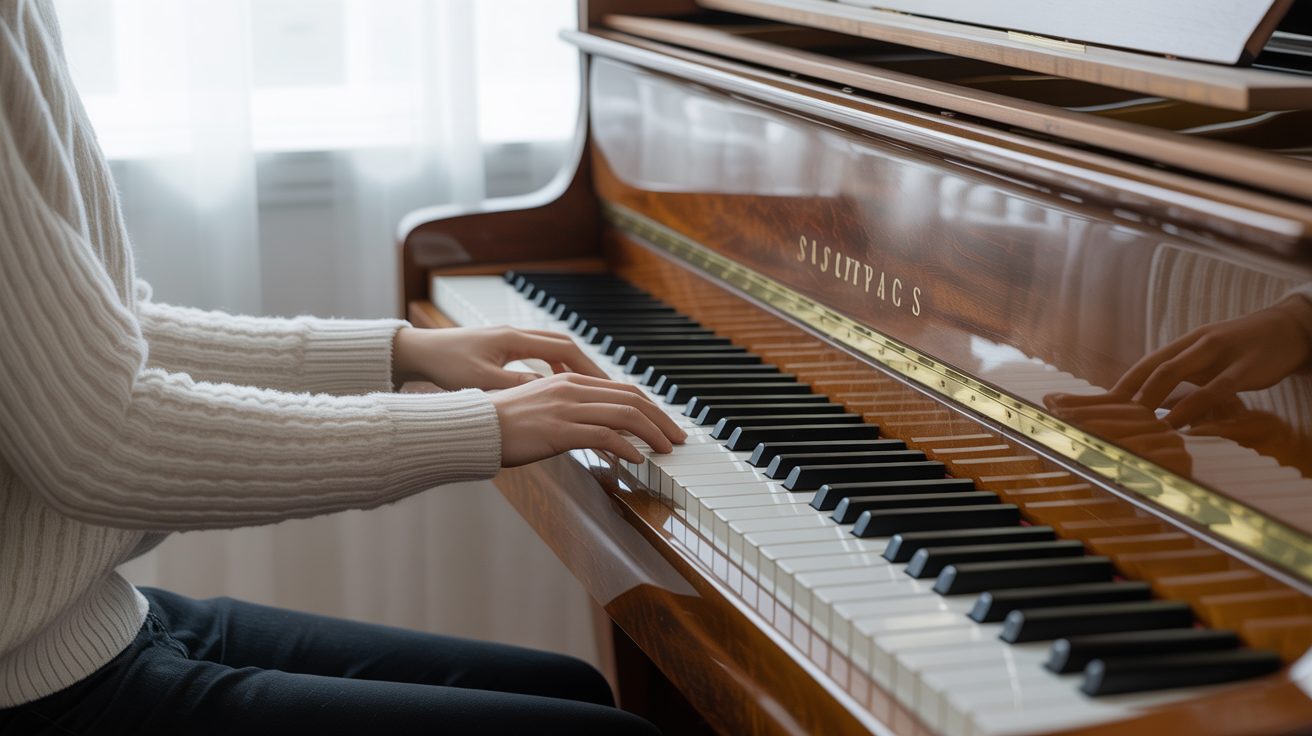
Practicing piano slowly is the single most effective thing a beginner can do to learn a piece accurately. Not because slow is easy (it's often harder) but because your hands can only learn what they actually do. When you play faster than you can control, your fingers guess and fumble, and every repetition reinforces the fumble. Slow practice stops that cycle. It gives your muscles time to form the right movement before that movement gets locked in.
This guide explains exactly how to practice slowly, what "slow" means in practice, and how to use a metronome to climb back up to full tempo without losing accuracy on the way.
Why your brain needs slow repetitions
When you repeat a movement, your nervous system gradually wraps the neurons involved in a layer of myelin, a fatty sheath that speeds signal transmission. This process is what musicians mean when they talk about "muscle memory." The more times you repeat a movement correctly, the faster and more automatic it becomes.
The catch: your nervous system doesn't distinguish between correct and incorrect repetitions. It myelinates whatever you do repeatedly. Play a passage with a wrong fingering ten times, and your hands start to expect that wrong fingering. Play it a hundred times, and fixing it becomes a project.
Slow practice sidesteps this problem. At a low tempo, you have time to check each note before playing it, adjust finger placement, and use the right fingering throughout. Each correct repetition counts toward the movement your hands will eventually do at speed.
What "slow" actually means
There's no universal slow tempo. "Slow" means slow enough that you make zero mistakes. If you stumble even once, you're still going too fast.
A practical test: play a passage and consciously say the name of each note in your head before you press the key. If you can do that and keep playing, you're at a tempo your brain can supervise. If you're pressing keys before you've thought about them, speed down.
For most beginners working on a new piece, this lands around 40–50 BPM on a metronome, even when the final target tempo is 120 BPM or faster. That gap feels discouraging at first. It's actually a good sign: you've found the tempo where learning happens.
How to practice slowly: a step-by-step method
This sequence works for any passage you're learning, from a single bar to a whole section.
- Find your zero-mistake tempo. Play the passage once without a metronome, going as slowly as you need to. No wrong notes, no hesitations.
- Set the metronome 10–20 BPM below that. You want to feel slightly bored by how slow it is. That's correct.
- Play the passage five times in a row without a single mistake. If you make an error, start the count over. Don't push through errors. Stop, reset to the beginning of the phrase, and go again.
- Raise the tempo by 4–5 BPM. Repeat five clean passes.
- Stop before your session ends. Don't run the tempo all the way to full speed in one sitting. Your hands consolidate what they've learned during rest, not during playing. End at a tempo where you feel solid, not stretched.
The only rule for moving the tempo up: it goes up when the passage is clean, not when you're tired of the current speed.
The metronome's real job
Most beginners use a metronome to stay in time. That's part of it. The bigger job is giving you an objective reference so you don't accidentally speed up inside a passage.
Humans tend to rush through the notes they know well and slow down through the notes they're unsure of. This feels even from the inside but sounds uneven to a listener. A metronome reveals the truth. If you're lunging ahead of the click in bar two, that's where your confidence runs out and your hands start guessing.
Set the metronome and play with it for a few passes before you adjust anything. Just listen to where you're early, where you're late. That tells you which bars need the most slow-practice attention.
If you want a full walkthrough on metronome use, the guide on how to use a metronome to improve your timing covers subdivisions and how to work with a click when you're playing complex rhythms.
The impatience trap (and how to recognize it)
The most common way slow practice breaks down: it's working, and you get bored and speed up.
A few forms this takes:
- Playing the passage once slowly, then again faster "just to hear how it sounds"
- Staying at the same tempo but no longer monitoring each note
- Skipping the five-clean-passes rule and moving up after two or three repetitions
- Deciding a small error "doesn't count"
Every one of these shortcuts teaches your hands a slightly wrong version of the passage. The damage is cumulative. A week of impatient practice can create errors that take two weeks to remove.
A useful reframe: the goal of a slow-practice session is not to get faster. The goal is to play the passage correctly more times than you played it incorrectly. That's it. Speed will arrive on its own once correct movements are established.
Practicing hands separately
One situation where slow practice alone isn't enough: when both hands are doing different things and your brain can't supervise both at once.
The solution is the same slow-practice method, applied to one hand at a time. Learn the right hand until it's automatic at a given tempo. Learn the left hand separately until it's automatic. Then bring them together at a tempo even slower than either hand alone, because combining them adds cognitive load.
This feels tedious. It's also the fastest path to playing a piece hands-together accurately.
Building a practice routine around slow work
Slow practice is most effective when it's a deliberate part of a session rather than the whole session. A reasonable structure for a 20-minute practice:
- 3–5 minutes warming up with scales or something already learned
- 10–12 minutes of slow practice on whatever is newest or least clean
- 3–5 minutes playing through things you already know to end on a confident note
Within that middle block, focus on short passages: four bars or fewer. Practicing a 32-bar piece slowly from beginning to end is not the same as practicing its four most difficult bars with the five-passes method. The latter fixes errors; the former just discovers them.
For a broader look at how to structure your time, the guide on building a daily piano practice routine covers how to balance new learning, technical work, and repertoire review across a week.
One more consideration for beginners: how long you practice matters less than how consistently you practice. Thirty minutes a day outperforms two-hour weekend sessions for building motor skill. If you're not sure how much time to commit, the guide on how long beginners should practice piano each day gives realistic guidance based on your goals.
Frequently Asked Questions
How slow is slow enough?
Slow enough that you can name every note before you play it. If you're pressing keys faster than you're thinking about them, drop the tempo. There's no number that works for everyone. A beginner working on a simple melody might find 60 BPM comfortable, while a more advanced player tackling a difficult passage might need 30 BPM.
How long should I stay at a slow tempo before speeding up?
Until you can play the passage five consecutive times without any errors. Not four out of five, not "mostly clean": five clean passes in a row. Then raise the tempo by 4–5 BPM and repeat. This is slower than it sounds; a single difficult bar might take 15–20 minutes to move up 20 BPM. That's normal.
Is it okay to play through a passage faster sometimes to hear the full piece?
Occasionally, yes, as a listening exercise. The problem is when playing-through replaces slow practice. If you play through fast and notice errors, that's information. Go back and slow-practice the bar where the error happened. Don't use a run-through as a substitute for fixing what's wrong.
Why do I keep making the same mistake even after slow practice?
Usually one of three things: you're not going slow enough, you're not doing the five-passes method (you're moving on after fewer clean repetitions), or there's a fingering problem that needs to be addressed before practice can fix it. Check your fingering first. If you're using an awkward finger on a note, slow practice will myelinate the wrong movement and the error will persist.
When should I stop for the day?
Before your playing gets worse. Fatigue produces errors, and errors produce bad repetitions. A good stopping point is just before you feel your accuracy drop off, not when you've "finished" a passage or hit a time target. Short, accurate sessions teach more than long, sloppy ones.