Reading Music
How to Count Time and Read Time Signatures (4/4, 3/4)
Learn to read time signatures at the piano: what 4/4, 3/4, and 2/4 mean, how to count beats per measure, and what the top and bottom numbers tell you.
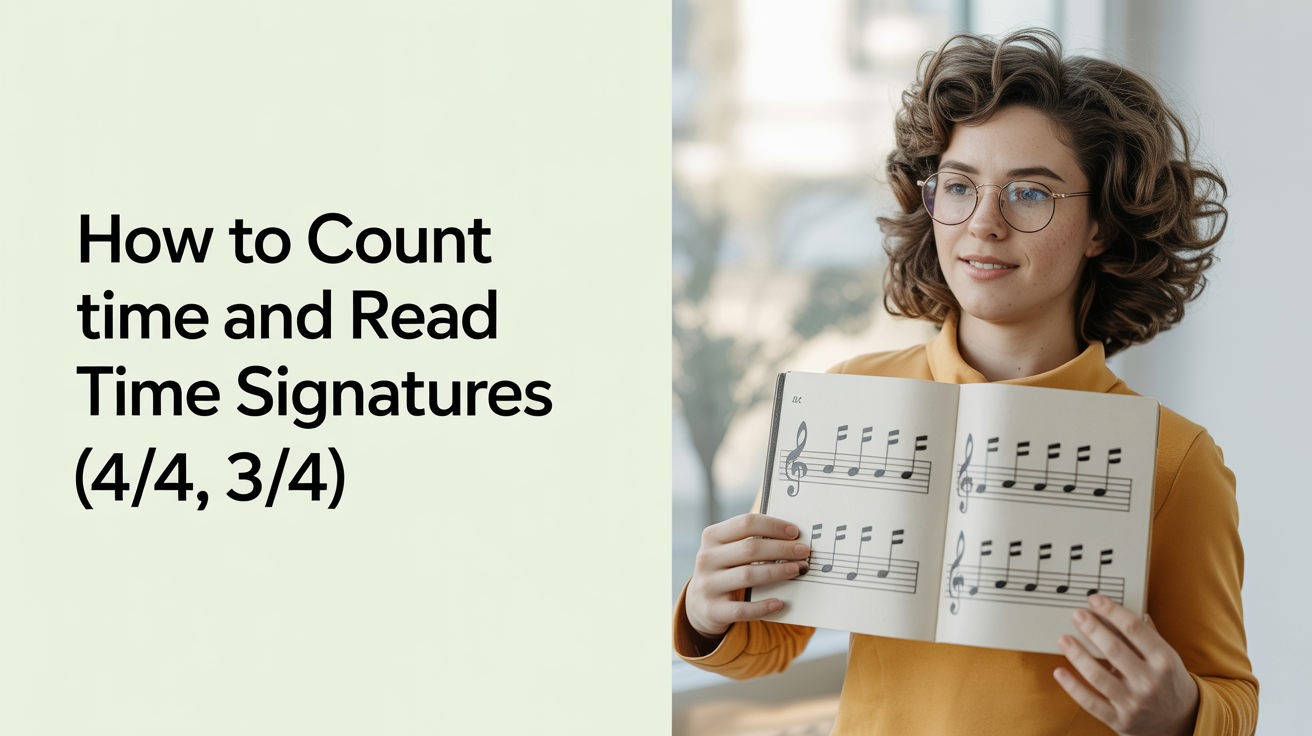
When you pick up a piece of sheet music, one of the first things you'll see after the clef is a pair of numbers stacked on top of each other. That's the time signature, and it tells you two things: how many beats fit in each measure, and what kind of note gets one beat. Once you can read it, you have the rhythmic map for the whole piece.
This guide covers how to read time signatures, what the numbers mean individually, and how to count through the most common ones at the piano. No prior theory knowledge needed.
What a time signature actually is
A measure (also called a bar) is a small chunk of music between two vertical lines on the staff. Every measure holds the same amount of rhythmic space. The time signature tells you how much space that is.
The two numbers are stacked like a fraction but they are not a fraction. Each number has a separate job:
- The top number tells you how many beats are in each measure.
- The bottom number tells you which note value equals one beat.
The bottom number uses a code:
| Bottom number | Note it represents | Common name |
|---|---|---|
| 1 | whole note | whole-note beat |
| 2 | half note | half-note beat |
| 4 | quarter note | quarter-note beat |
| 8 | eighth note | eighth-note beat |
In most beginner music you'll see a 4 on the bottom, meaning the quarter note gets one beat. That's also the note beginners count most naturally, so it's a good place to start.
If you need a refresher on what these note shapes look like on the page, how to read notes on the grand staff covers each one with its position on the lines and spaces.
Reading 4/4 time
4/4 is the most common time signature in Western music. You'll see it on everything from pop songs to beginner method books.
Top number: 4 — four beats per measure.
Bottom number: 4 — the quarter note gets one beat.
When you count through a measure of 4/4, you say: 1 – 2 – 3 – 4, then start again at 1 in the next measure.
A whole measure could be filled with four quarter notes (one per beat), or it could be filled with any combination of notes and rests that adds up to four quarter-note beats. A half note, for example, lasts two beats, so you'd hold it for counts 1 and 2, then play the next note on count 3.
4/4 is sometimes called common time and written with a large C instead of the numbers. They mean exactly the same thing.
Counting out loud at the piano
The most useful habit you can build early is counting aloud while you play. Pick a slow, steady tempo. Say "1" as your finger lands on the first note, "2" as it lands on the second, and so on. When you get to "4" and finish that beat, the next note starts at "1" again.
If a note lasts more than one beat, keep counting through it. A half note on beat 1 gets "1... 2..." while your finger stays down, and then you play the next note on 3.
Reading 3/4 time
3/4 time has three beats per measure, and the quarter note still gets one beat. You count: 1 – 2 – 3, then back to 1.
This is the time signature of waltzes. If you've ever heard that characteristic long-short-short feel of a waltz, that's 3/4: a strong beat on 1 followed by two lighter beats.
Because there are only three beats instead of four, measures feel shorter and the music often has a lilting, circular quality. The first beat of each measure carries a natural accent, which is why waltz accompaniment patterns often play a bass note on beat 1 and chords on beats 2 and 3.
A whole measure of 3/4 could hold three quarter notes, or a dotted half note (which lasts exactly three beats), or other combinations that add up to three quarter-note beats.
Reading 2/4 and cut time
2/4 has two quarter-note beats per measure. You count 1 – 2, 1 – 2. Marches are often written in 2/4 because the two-beat pattern matches left-right stepping. The music feels brisk and direct.
Cut time (written as a C with a vertical line through it, or as 2/2) has two beats per measure, but the half note gets one beat rather than the quarter note. In cut time the music often moves faster because the half note beat drives the tempo forward. You still count 1 – 2, but each beat covers more rhythmic ground.
Common time signatures compared
Here's a side-by-side view of the time signatures beginners encounter most:
| Time signature | Beats per measure | Beat unit | Count | Common in |
|---|---|---|---|---|
| 4/4 (common time) | 4 | quarter note | 1 – 2 – 3 – 4 | Pop, classical, hymns |
| 3/4 | 3 | quarter note | 1 – 2 – 3 | Waltzes, ballads |
| 2/4 | 2 | quarter note | 1 – 2 | Marches, folk dances |
| 2/2 (cut time) | 2 | half note | 1 – 2 | Faster classical pieces |
| 6/8 | 6 | eighth note | 1–2–3–4–5–6 | Compound feel, lilting |
6/8 deserves a note: it has six eighth-note beats per measure, but at moderate or fast tempos it's usually felt in two larger groups of three (think of a rocking boat). Beginners usually encounter it a little later, but it's worth knowing the name.
Where the time signature sits on the page
The time signature appears at the very beginning of a piece, right after the clef symbol and the key signature. It only appears once at the start (or wherever the meter changes), not at the beginning of every line.
If you open a beginner's sheet music guide, you'll usually see: treble clef, then any sharps or flats for the key, then the time signature. On the bass clef staff directly below, the time signature repeats so you can see it for both hands at a glance.
When the time signature changes mid-piece, a new pair of numbers appears at that exact spot in the music. This isn't common in beginner repertoire, but it does happen.
For a closer look at how the clef symbols themselves work, the treble clef and bass clef explained for pianists walks through what each one means and why the piano uses both.
A practical counting exercise
Try this without even playing a note. Tap your hand on a flat surface:
- Set a slow, even tempo, about one tap per second.
- Count aloud: 1 – 2 – 3 – 4, 1 – 2 – 3 – 4. Stress the "1" slightly each time. That's 4/4.
- Now switch: 1 – 2 – 3, 1 – 2 – 3. Notice the different grouping. That's 3/4.
- Now: 1 – 2, 1 – 2. That's 2/4.
The physical feel of each meter is different before you even touch the keys. That sense of grouping is exactly what the time signature communicates.
When you move to the piano, keep tapping your foot or nodding your head on the beat while you play. The goal is for the counting to become automatic enough that you don't have to think hard about it, just feel it.
Frequently Asked Questions
What does the bottom number in a time signature mean?
The bottom number names the note value that equals one beat. A 4 means the quarter note gets one beat. An 8 means the eighth note gets one beat. A 2 means the half note gets one beat. It's a code that translates note shapes into beat units for that particular piece.
Is 4/4 the same as common time?
Yes. Common time is just an older shorthand for 4/4, written as a capital C. They tell you exactly the same thing: four beats per measure, quarter note gets one beat. Many printed scores use the C symbol rather than the numbers, so it's worth recognizing both.
How do I know which beat to stress when I'm counting?
In most time signatures, beat 1 carries a natural accent. In 4/4, beats 1 and 3 are stronger than 2 and 4 (with 1 strongest). In 3/4, beat 1 is accented and beats 2 and 3 are lighter. In 2/4, both beats carry weight but 1 is slightly stronger. You don't need to hammer these accents as a beginner, but feeling where beat 1 falls helps you stay oriented in the measure.
What happens if I lose count while playing?
Stop, find your place in the score, and start again from the beginning of that measure. Look at the note values written out and count them against the time signature before you play. This is more useful than trying to recover mid-phrase. Most beginners lose their place because the tempo is too fast, so slowing down is almost always the right fix.
Can a song change time signatures?
Yes, though it's unusual in beginner pieces. When the time signature changes, a new set of numbers appears mid-staff and takes effect immediately from that measure onward. Some classical pieces change meter frequently, and some modern songs alternate between two time signatures. For now, the pieces you're learning almost certainly stay in one time signature throughout.