Chords & Harmony
How to Play Chord Inversions and Why They Matter
Learn piano chord inversions for beginners: what they are, how to finger them, and how they make chord changes smoother and music sound more connected.
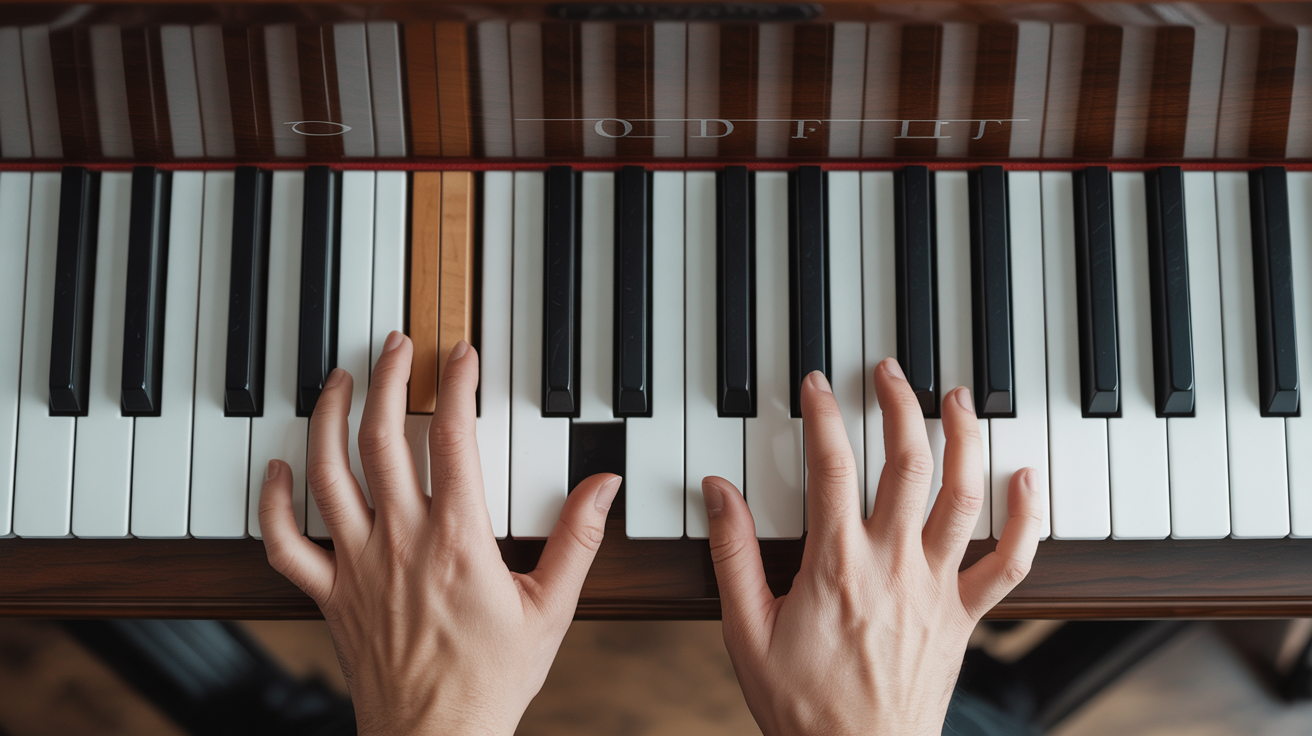
Once you know a handful of chords, you might notice something awkward: jumping from C major to F major means your hand has to leap across several keys. Chord inversions solve that. They let you rearrange the notes of a chord so your hand barely moves between chords, and the music flows instead of lurching.
This guide explains what inversions are, how to find and finger them, and how to use them in real playing.
At a Glance
- Every triad has three positions: root position, first inversion, and second inversion, all using the same three notes.
- Root position puts the root at the bottom (C-E-G for C major); first inversion puts the third at the bottom (E-G-C); second inversion puts the fifth at the bottom (G-C-E).
- Inversions do not change a chord's name or identity, only which note sits lowest.
- Choosing inversions that share or minimize note movement between chords is called voice leading, and it's why progressions can sound connected instead of jumpy.
- Slash chords like C/E or C/G on a lead sheet are just a shorthand for "this chord, in this inversion."
- Every triad, major or minor, has the same three positions; the process for finding them is identical.
What Are Chord Inversions?

Every chord is built from a stack of notes. A C major chord uses the notes C, E, and G. The way you arrange those three notes changes which one sits at the bottom.
- Root position puts the root (C) at the bottom: C - E - G
- First inversion puts the third (E) at the bottom: E - G - C
- Second inversion puts the fifth (G) at the bottom: G - C - E
All three versions contain exactly the same three notes. The chord's identity stays the same. Only the lowest note and the shape of the voicing change. Music theory calls this relationship inversion: the label describes how the other notes sit relative to the lowest one, not a different chord.
If you have already spent time with piano chords for beginners, you already know root-position chords. Inversions are just those same chords rearranged.
How to Build and Finger Inversions
Take the C major chord (C - E - G) as a starting example.
Root position:   C  E  G    (fingers 1 - 3 - 5)
First inversion: E  G  C    (fingers 1 - 2 - 5)
Second inversion: G  C  E   (fingers 1 - 3 - 5)
The fingering changes slightly because the intervals between the notes change. In first inversion, E and G are a whole step apart, so fingers 1 and 2 sit closer together than in root position.
Step-by-Step: Finding First Inversion
- Play root-position C major with your right hand: C (thumb), E (middle finger), G (pinky).
- Lift just the C and move it up one octave, so it lands above the G.
- You now have E - G - C from bottom to top.
- Settle into a relaxed hand shape. Many beginners use fingers 1 - 2 - 5 here, though 1 - 3 - 5 also works on some hand shapes.
Step-by-Step: Finding Second Inversion
- Start from first inversion (E - G - C).
- Move the E up one octave so it lands above the C.
- You now have G - C - E from bottom to top.
- Fingers 1 - 3 - 5 works naturally here.
Once you have these for C major, apply the same logic to G major (G - B - D) and F major (F - A - C). Those three chords appear in dozens of songs, and their inversions connect smoothly.
You can also look at how to build major and minor triads on the piano to reinforce the note choices before drilling the inversions.
Why Inversions Make Chord Changes Smoother
Root-position chords are the right place to start learning. But when you play chord progressions using only root position, the hand jumps around quite a bit. Inversions let you pick the version of each chord that keeps your hand close to where it already is.
Here is a practical comparison. In the key of C, you might play C - F - G - C repeatedly.
All root position:
C major root:  C E G
F major root:  F A C  (hand jumps up a fourth)
G major root:  G B D  (hand jumps up again)
C major root:  C E G  (hand jumps back down)
Using inversions to stay in one area:
C major root:       C E G
F major 2nd inv:    C F A  (just move two fingers)
G major 1st inv:    B D G  (small shift)
C major root:       C E G  (return home)
The second version keeps your hand hovering around the same cluster of keys. Notes that stay the same between chords can even hold in place or move by just one step, which creates a smoother, more connected sound.
This technique has a name in music theory: voice leading. The general rule is to move each note the shortest distance possible from one chord to the next, keeping any shared notes in place rather than replaying them from scratch. You do not need to memorize the term to use the concept, but knowing it helps when you see it mentioned in lessons or books.
How much distance inversions actually save
It helps to see the difference in real numbers, counted in half steps (the distance from one key to the very next key, black or white).
| Move | All root position | Using inversions | Half steps saved |
|---|---|---|---|
| C major → F major | Thumb jumps from C to F, 5 half steps | C major root to F major 2nd inversion (C-F-A): thumb stays on C | 5 |
| F major → G major | Thumb jumps from F to G, 2 half steps | F major 2nd inversion to G major 1st inversion: top note G stays, others shift 1-2 half steps | roughly 1-3 per note |
| G major → C major | Thumb jumps from G to C, 5 half steps | G major 1st inversion (B-D-G) to C major root (C-E-G): G stays, B moves 1, D moves 2 | roughly 3-4 |
Root position alone racks up over a dozen half steps of hand travel across a short four-chord loop. Choosing inversions that share notes cuts that dramatically, which is the actual mechanism behind the "smoother" sound: less physical jumping means less risk of missed notes and a more connected line under your fingers.
A Practical Chord Inversion Reference
The table below shows root position, first inversion, and second inversion for five common chords. All notes listed left to right, low to high.
| Chord | Root Position | First Inversion | Second Inversion |
|---|---|---|---|
| C major | C - E - G | E - G - C | G - C - E |
| G major | G - B - D | B - D - G | D - G - B |
| F major | F - A - C | A - C - F | C - F - A |
| A minor | A - C - E | C - E - A | E - A - C |
| D minor | D - F - A | F - A - D | A - D - F |
Once you learn to read chord symbols and lead sheets, you will sometimes see inversion notation like C/E (a C chord with E in the bass, meaning first inversion) or C/G (second inversion). The slash just tells you which note goes in the bass.
How to Practice Inversions
Start With One Chord, All Three Positions
Take C major. Play root position, then first inversion, then second inversion, going up the keyboard. Then come back down: second inversion, first inversion, root. Say the bottom note aloud as you play each one. This builds both the physical shape and the note recognition at the same time.
Do this slowly. If you feel any strain in your wrist or fingers, stop and shake out your hands. The inversion shapes are not awkward once you know them, but they can feel unfamiliar at first.
Connect Two Chords With Smooth Voice Leading
Pick C major and G major. Practice moving between them using whichever inversions keep your hand in roughly the same position. A common pair:
C major root:      C E G
G major 1st inv:   B D G
The G stays in place. Only C moves down to B, and E moves down to D. That is as smooth as chord transitions get.
Once that feels comfortable, add a third chord. Keep drilling until the movement feels automatic before speeding up.
Use a Metronome at a Slow Tempo
Set it to 60 beats per minute and play one chord per beat. Once you can move between all three chords cleanly at that speed, bump up to 66 or 70. There is no rush to go fast. The goal is clean, confident movement.
A common pitfall: choosing an inversion just because it's "correct"
Not every inversion is the right choice in every context. A common beginner mistake is picking whichever inversion technically exists rather than the one that actually minimizes hand movement for the specific chords on either side of it. Before settling on a fingering, look at both the chord you're leaving and the chord you're heading toward, and pick the inversion that shares the most notes or requires the smallest jump between the two. The "right" inversion changes depending on context, not a fixed rule per chord.
Frequently Asked Questions
Do I need to learn inversions right away, or can I wait?
You can start playing songs with root-position chords first. But inversions become useful quickly once you try to play anything that moves between chords. Most beginners find them worth tackling after a month or two of basic chord work.
Do inversions change the chord's name?
No. A C major chord in first inversion is still C major. The inversion changes the voicing and which note is on the bottom, but the chord name stays the same unless a lead sheet specifically marks a bass note with slash notation.
How do I know which inversion to use?
Choose the one that keeps your hand closest to its current position. In a C to F progression, look for the F inversion where a note in F is close to a note you just played in C. Over time this becomes instinctive.
Are inversions the same in both hands?
Yes, the same note arrangements apply to the left hand. Left-hand inversions come up in more advanced accompaniment, but for now it is fine to practice them in the right hand only and focus on the concept.
Do minor chords have inversions too?
Absolutely. Every triad, major or minor, has root position, first inversion, and second inversion. The process is the same: move the bottom note up an octave to get to the next inversion. A minor (A - C - E) in first inversion is C - E - A, and in second inversion is E - A - C.
Can inversions make a chord sound weaker or less stable?
Yes, and that's actually useful. Root position generally sounds the most stable and "resolved," which is why pieces tend to end on a root-position chord. Second inversion in particular can sound a little unsettled on its own, which is why it's often used as a passing chord in the middle of a phrase rather than as a final landing point. Knowing this helps you choose inversions not just for hand comfort but for the effect you want at a given moment in the music.