Getting Started
How to Start Learning Piano: A Complete Beginner's Roadmap
Learn how to start learning piano with this hands-on beginner's guide: gear, posture, first notes, reading music, and a realistic practice plan.
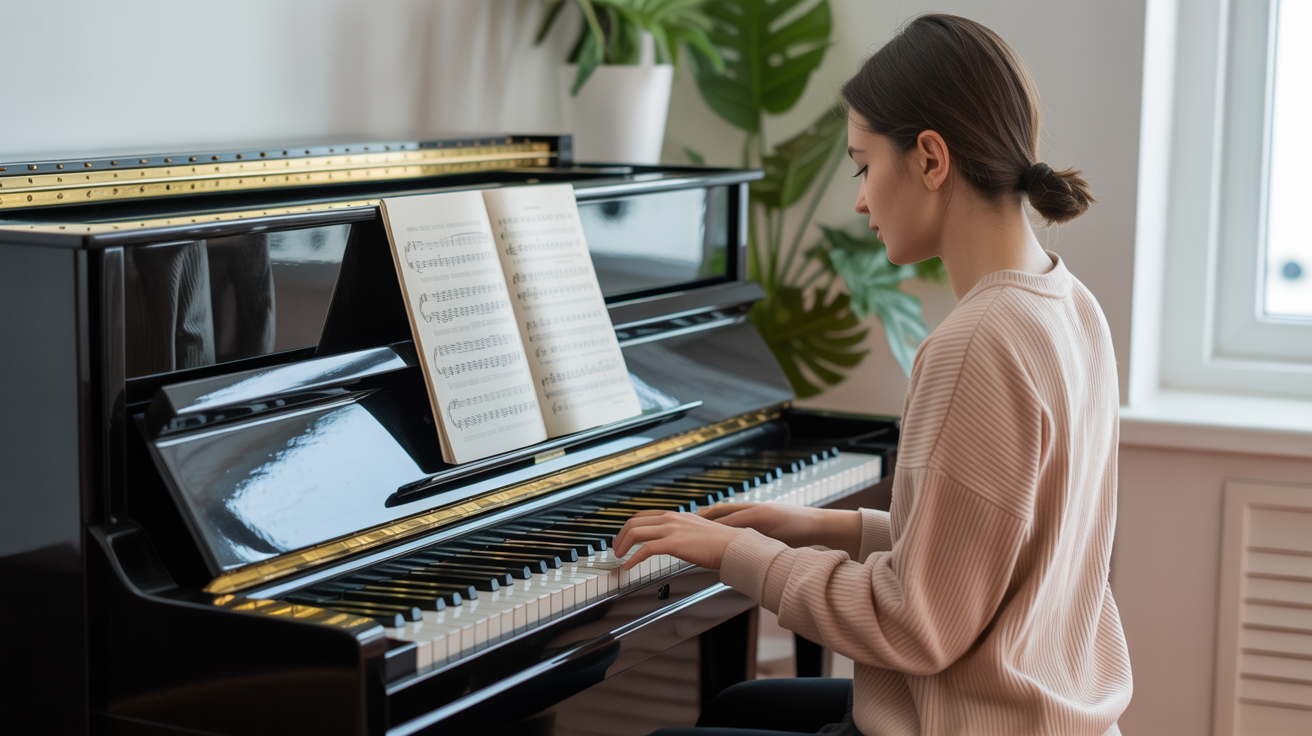
If you want to know how to start learning piano, the short answer is: sit down, find middle C, and play a single note. That's it. The elaborate mental picture most people have (years of lessons, a full 88-key grand, hours of daily practice) isn't wrong exactly, but it makes the entry point seem much further away than it is. This guide will walk you through everything you actually need to get going, from picking the right instrument to reading your first notes on the staff, so you can spend less time planning and more time playing.
What equipment do you actually need?
You don't need a concert grand to start. A basic digital keyboard or an acoustic upright both work fine for a beginner, and each has real trade-offs worth understanding before you spend anything.
An acoustic piano has weighted keys that respond to how hard you press them (called "touch sensitivity" or "velocity sensitivity"). That physical resistance builds finger strength and teaches you dynamics—the difference between playing softly and loudly. That matters from day one. The downside is cost, size, and the fact that it needs tuning twice a year.
A digital piano or keyboard is cheaper, quieter (headphone jack), and requires zero maintenance. A quality digital instrument can closely mimic the feel of acoustic keys, though budget models often feel lighter and springier. If you're just starting out and aren't sure this will stick, a mid-range digital piano is a perfectly reasonable place to begin.
Two questions worth settling early: how many keys do you need, and what's the difference between a "keyboard" and a "digital piano"? A full piano has 88 keys, but many beginner models come in 61- or 76-key versions. For most beginner repertoire, 61 keys is enough. The 61 vs 76 vs 88 key debate is worth reading before you buy. And if you're not sure which category of instrument fits your situation, this breakdown of digital pianos, keyboards, and acoustic options covers the differences plainly.
One non-negotiable: whatever you buy, make sure it has at least 61 touch-sensitive keys. Playing on an instrument where every note sounds the same volume regardless of pressure will teach you bad habits that take a while to undo.
Finding your footing on the keys
Before you read a single note of music, spend a few minutes just exploring the keyboard with your eyes.
The piano has 88 keys arranged in a repeating pattern of white and black keys. The black keys come in groups of two and three, and that pattern repeats across the whole keyboard. This is your map.
Middle C is the single white key immediately to the left of the group of two black keys closest to the center of the keyboard. It's called middle C because it sits roughly in the middle of the 88-key range, and it's also the note that sits on a small line (called a ledger line) between the treble clef and bass clef staffs on sheet music. If you're still not certain where to find it, this guide to locating middle C walks through it step by step with visuals.
Once you've found middle C, try this: play each white key from C upward, saying the letter names aloud as you go. The white keys follow the alphabet from A to G, then repeat. Starting from middle C: C, D, E, F, G, A, B, then back to C (one octave higher). An octave just means the same note name but at a higher or lower pitch.
Finger numbers and basic hand position
Pianists number their fingers 1 through 5 on each hand, starting with the thumb.
- Thumb = finger 1
- Index finger = finger 2
- Middle finger = finger 3
- Ring finger = finger 4
- Pinky = finger 5
This numbering shows up in sheet music, method books, and every exercise you'll ever do, so get comfortable with it now.
For hand position: sit with your forearms roughly parallel to the floor, wrists relaxed (not bent sharply up or down), and fingers gently curved as if you're holding a tennis ball. Your fingertips, not your flat finger pads, should contact the keys. This curved position lets your fingers move independently without your whole hand flopping around.
A practical first exercise: place your right hand on the keyboard with finger 1 on middle C. Now play each finger in order (1-2-3-4-5), landing each finger on the next white key to the right. You'll play C-D-E-F-G. Do the same with your left hand, but mirror it: place finger 5 on the C one octave below middle C, and play upward (5-4-3-2-1), landing on C-D-E-F-G. This is called a five-finger position, and nearly every beginner method starts here.
Stop immediately if any motion causes pain or discomfort. Finger exercises should feel mildly tiring at most, not sharp or strained. Hands vary, and what works as a starting position for one person may need adjustment for another.
Reading music: the basics you need to know
Sheet music for piano is written on a grand staff, which is two five-line staffs stacked vertically, connected by a brace. The top staff uses the treble clef (it looks like a stylized G and curls around the second line from the bottom). The bottom staff uses the bass clef (it looks like a reversed C with two dots, and marks the fourth line from the bottom as F).
Notes on the staff
Notes are oval shapes placed on or between the five lines of a staff. The higher the note sits on the staff, the higher the pitch on the keyboard.
For the treble clef, the lines from bottom to top are E, G, B, D, F. A common memory trick: "Every Good Boy Does Fine." The spaces spell FACE, bottom to top.
For the bass clef, the lines from bottom to top are G, B, D, F, A ("Good Boys Do Fine Always"). The spaces spell ACEG ("All Cows Eat Grass").
You don't need to memorize all of this on day one. Start by learning just a handful of notes around middle C and add more as your reading speed picks up. Most beginner method books introduce notes gradually over weeks, not all at once.
Note values and rhythm
Notes also tell you how long to hold each pitch:
| Note name | Symbol | Duration (in 4/4 time) |
|---|---|---|
| Whole note | Open oval | 4 beats |
| Half note | Open oval with stem | 2 beats |
| Quarter note | Filled oval with stem | 1 beat |
| Eighth note | Filled oval with stem and flag | 1/2 beat |
Most beginner pieces start with quarter notes and half notes in 4/4 time, which means four beats per measure. A measure is the chunk of music between two vertical bar lines on the staff. Counting aloud while you play ("one, two, three, four") keeps your rhythm steady and is a habit worth building from the beginning.
Building a practice routine that actually works
Here's an honest observation: twenty minutes of focused daily practice will get you further than a two-hour session on the weekend. The piano rewards consistency over volume.
A reasonable starter routine for your first few weeks:
- Warm up (3-5 min): Play your five-finger exercises on both hands separately, then together. Keep the tempo slow enough that every note is clean.
- Technique (5 min): Work on one specific skill, whether that's a scale, a hand-position drill, or a tricky passage from a piece you're learning.
- Repertoire (10-12 min): Work through whatever piece or exercise you're currently learning. When a section gives you trouble, isolate it, slow it down, and repeat it five or six times before moving on.
- Play for fun (3-5 min): Improvise, pick out a melody you know by ear, or just explore. This is the part that keeps you coming back.
A metronome (physical or app-based) is worth using almost immediately. Playing in time is a skill in itself, and developing it early saves you from correcting sloppy rhythm later.
How quickly can you expect to play something recognizable? Most beginners can pick out simple melodies in their first week. A short, complete piece, something like a simplified folk melody or a basic étude from a beginner method, usually comes together within four to eight weeks of regular practice. Progress isn't perfectly linear, and some weeks feel slower than others. That's normal.
Common beginner mistakes (and how to avoid them)
A few patterns come up repeatedly with new players:
- Practicing too fast. If you're making mistakes at your current tempo, slow down. The brain learns the mistakes as readily as the correct notes.
- Skipping hands-separate practice. Working each hand alone before combining them is slower in the short run but faster overall. The hands are doing different things, and they need individual attention.
- Ignoring dynamics and touch. Playing every note at the same volume makes music flat. Even simple pieces come alive when you experiment with louder and softer passages.
- Holding tension in the wrists or shoulders. Check in with your body every few minutes during practice. Tension creeps in quietly and can lead to fatigue or strain over time.
- Jumping ahead before basics are solid. It's tempting to skip to harder pieces before your foundational skills are there. A few extra weeks on fundamentals pays off substantially.
Frequently Asked Questions
How long does it take to learn piano as a beginner?
It depends on what "learn" means to you. Playing simple songs with both hands and reading basic sheet music is achievable within a few months of consistent practice. Playing intermediate repertoire fluently takes most people one to two years of regular work. The honest range is wide, because it depends heavily on how often you practice and how deliberate that practice is.
Do I need to learn to read sheet music, or can I just learn by ear?
Both are legitimate paths. Reading music opens up an enormous library of written repertoire and makes it much easier to communicate with other musicians. Learning by ear develops a strong sense of pitch, melody, and phrasing. Most players benefit from developing both over time, but if you're drawn to a particular style of music, let that guide which one you emphasize first.
Can adults learn piano, or is it only for kids?
Adults learn piano all the time, and adult beginners often have real advantages: patience, a clearer sense of what they want to play, and the ability to understand explanations quickly. Progress may feel slower than a child who practices daily, but adults who practice consistently make meaningful progress within months.
Do I need a piano teacher, or can I learn on my own?
A teacher catches technical problems early, which can save you from developing habits that are painful to correct later. That said, many people have learned piano well using quality method books, online resources, and consistent self-directed practice. If budget or access is a barrier, self-study is a real option. If you're serious about developing technique over the long term, lessons are worth the investment.
What's the first song I should learn?
Start with something you genuinely want to play. Method books suggest pieces pedagogically (they're ordered to introduce skills in a useful sequence), but your own motivation matters more than any curriculum. Simple versions of familiar melodies tend to work well: they keep you engaged because you already know what the music should sound like, which helps you hear your own mistakes.