Technique & Hands
How to Use the Sustain Pedal: A Beginner's Guide
Learn sustain pedal technique for piano beginners: when to press, when to release, and how to avoid muddy sound. Clear, practical guidance.
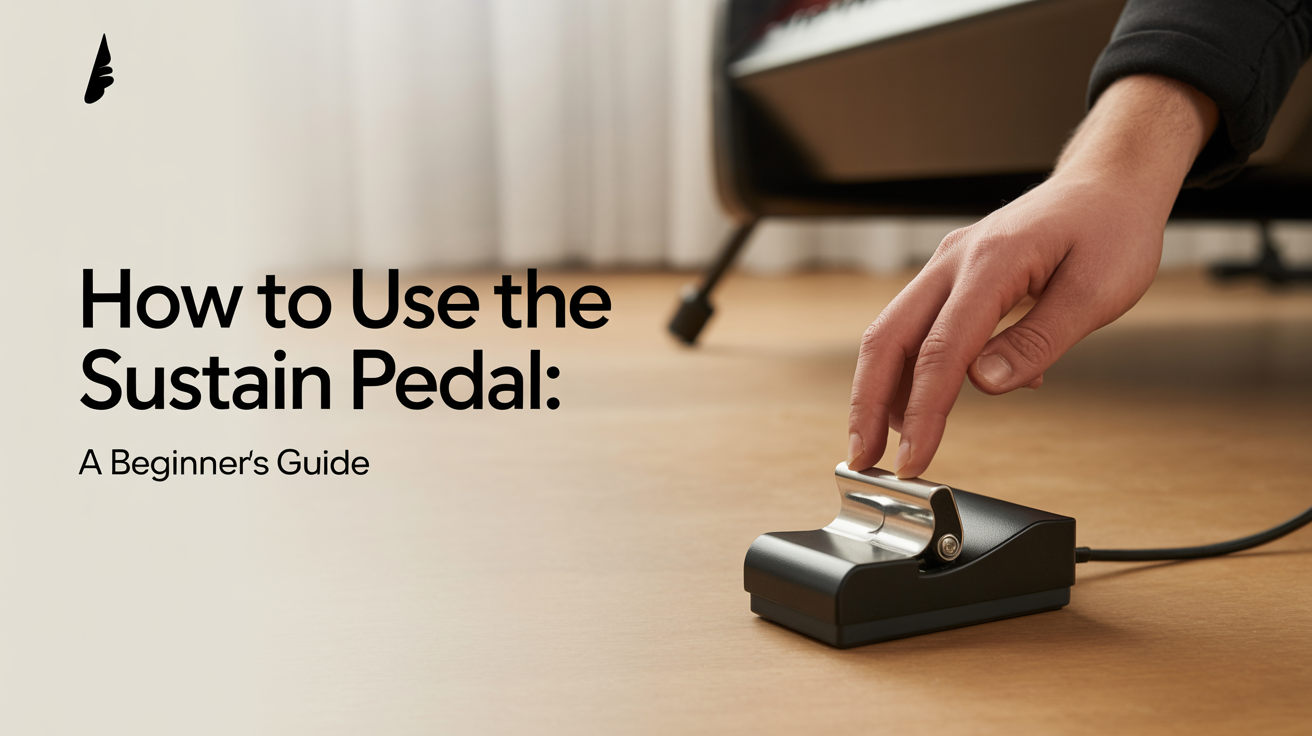
Press the sustain pedal and every note you play keeps ringing after you lift your fingers. That is its entire job. For beginners, it feels magical the first time. It can also make everything sound muddy if you hold it too long. This guide shows you how to control it so you get the ring without the blur.
What the Sustain Pedal Actually Does
On an acoustic piano, the sustain pedal (also called the damper pedal) lifts small felt pads away from the strings. While those pads are raised, the strings keep vibrating until they naturally fade out. Release the pedal and the pads drop back, stopping the sound immediately.
On a digital piano or keyboard the same logic applies in software, though the quality of the simulation depends on the instrument. A decent digital piano with a proper sustain pedal input will feel close to the real thing.
The sustain pedal is almost always the rightmost of the three pedals on an acoustic piano. On keyboards and many digital pianos, it is either a built-in rocker pedal or a separate jack where you plug in a footswitch (often sold as a "sustain pedal" or "damper pedal" accessory).
A note on the middle and left pedals: beginners can ignore these for now. The middle pedal on a grand piano sustains only notes already held down. The left pedal softens the tone. Neither is taught in early lessons, so we will focus entirely on the right pedal here.
Foot Position and Pressure
Sit at the piano with both feet flat on the floor. Your right foot moves slightly forward to rest on the sustain pedal, heel on the floor, ball of the foot on the pedal. You do not lift your heel off the ground to pedal; keep it anchored and rock your foot down from the ankle.
Press the pedal far enough that you feel it engage. On most instruments there is a slight give before it "catches." You want consistent, full depression, not a half-press that creates unreliable sustain.
Avoid tensing your calf or thigh. The motion is relaxed, the same kind of ankle movement you would use tapping your foot to a slow beat. If your leg cramps after a few minutes, check that your bench height lets your foot rest on the pedal naturally rather than stretching for it.
The Syncopated Pedal: The Core Technique
The most important skill in sustain pedal technique is called syncopated pedaling, also known as legato pedaling. Here is what it means in practice:
- Play the first chord or note with no pedal.
- Press the pedal down immediately after you play (not before, not at the same moment).
- Hold the pedal while you move your fingers to the next chord.
- The instant you play the next chord, release the pedal and press it right back down.
The timing looks like this in simple terms:
Play chord 1    → press pedal (hear chord 1 continue)
Play chord 2    → release + re-press pedal (old sound cleared, chord 2 now sustained)
Play chord 3    → release + re-press pedal
The key is that the pedal change happens on the beat, right as the new harmony lands. This gives you seamless connection between chords without blending two different harmonies into noise.
Practicing this slowly is the fastest way to lock in the reflex. Try it with just two chords, C major and G major, alternating once every two counts. Press down as you play C, change pedal exactly when you play G, change again on C, and so on. Listen for clean transitions. If you hear two chords blurring together, the release is happening a fraction too late.
When to Use the Pedal (and When Not To)
Piano pedaling for beginners often goes wrong in one of two directions: never using the pedal, or holding it down through everything. Neither works.
Use the pedal when:
- You are playing a slow or lyrical melody and want notes to flow smoothly into each other.
- The harmony stays on one chord for a full measure or more.
- You are playing arpeggios (broken chords) and want all the notes to ring together as a full chord sound.
- The music asks for a warm, resonant tone.
Avoid the pedal when:
- The harmony changes quickly (every beat or every half-beat). Each change needs a pedal change, and at fast tempos that becomes unmanageable for a beginner.
- You are practicing scales or technical exercises. Scales should be clean and separate; the pedal hides wrong notes and sloppy finger technique. When you work on piano finger numbers and correct fingering for beginners or how to play the C major scale with the right fingering, practice without the pedal first.
- The written music has staccato marks (dots above or below notes), which call for short, detached tones.
- You are sight-reading something new and your hands need full attention.
A practical rule: if you can hear two or more different chords blurring together, release the pedal.
Reading Pedal Markings in Sheet Music
Printed piano music often includes pedal markings, though older editions are sometimes inconsistent about them. The two most common notations are:
| Symbol | Meaning |
|---|---|
Ped or P | Press the sustain pedal here |
* or ⌒ (a bracket ending) | Release the sustain pedal here |
A long bracket [___] with a notch | Press at the start of the bracket, change pedal at each notch, release at the end |
The bracket style is increasingly common in modern editions and is easier to follow. The bracket starts where you press, dips at each change point, and ends where you release.
When a piece has no pedal markings, use your ear. Slow, romantic pieces almost always benefit from pedal. Baroque music (Bach, Handel) generally sounds cleaner without it, since the style calls for clear, separate lines rather than blended sustain.
A Simple Exercise to Build Pedal Coordination
This exercise connects your hands and foot in a single smooth motion. You do not need to read music to try it.
- Put your right hand on a C major chord (C, E, G).
- Play the chord, then immediately press the pedal. Hold both.
- Lift your fingers off the keys. The chord keeps sounding.
- Move your right hand to a G major chord (G, B, D) and pause with fingers ready.
- Play G major, then in the same instant release the old pedal and press it down again.
- Repeat steps 3-5 moving back to C major.
Do this at around 60 beats per minute, changing chords every two beats. Once it feels smooth, try it with your left hand playing single bass notes (C on beat 1, G on beat 3) while your right hand plays the chords. This is the foundation of most simple accompaniment patterns.
Once you are comfortable with two chords, expand to three: C major, F major (F, A, C), and G major. These three chords appear in hundreds of songs and will make good use of your new pedaling habit. For a broader map of what scales and chord patterns to tackle next, see beginner piano scales: which to learn first and why.
Frequently Asked Questions
Do I need a real piano pedal, or will any footswitch work?
Any footswitch with a standard 6.35 mm (quarter-inch) plug will work for basic sustain. The difference between a cheap footswitch and a quality sustain pedal is mainly feel; some higher-end digital pianos also support "half-pedaling," which requires a compatible continuous-control pedal rather than a simple on/off switch. For most beginners, a basic footswitch is fine to start.
My keyboard sustain pedal works backwards. How do I fix it?
Some footswitches have reversed polarity, meaning the pedal sustains when you release it and cuts off when you press it. Fix: power off the keyboard, hold the pedal down while you turn it on, then release. This polarity reset works on most digital pianos. If your keyboard has a polarity switch on the pedal input, toggle it.
Can I use the sustain pedal on a 61-key keyboard without weighted keys?
Yes. The pedal works the same way regardless of key count or action type. You may notice the sustain sounds different from an acoustic piano because the sound samples or synthesis differ, but the technique is identical.
I keep getting muddy sound even when I try to change the pedal. What am I doing wrong?
The most common cause is releasing the pedal too early or pressing it too late on the new chord. The change needs to happen right when the new note lands, in one smooth motion: play the new chord, then release-and-press in the same beat. Practice very slowly and listen closely. Also check that you are playing one harmony at a time; if your melody notes span two different chords without a pedal change, they will blend into mud regardless of timing.
Should I use the sustain pedal when learning my first songs?
It depends on the song. Many beginner pieces are written specifically so you can connect the notes with careful legato fingering instead of the pedal, which is actually good practice for your hands. Add the pedal once you can play the piece cleanly without it. That order gives you better finger control and makes the pedal an expressive tool rather than a crutch.