Chords & Harmony
Left-Hand Accompaniment Patterns for Beginner Pianists
Learn the most useful left-hand accompaniment patterns for beginners: root-fifth, broken chords, and Alberti bass explained step by step.
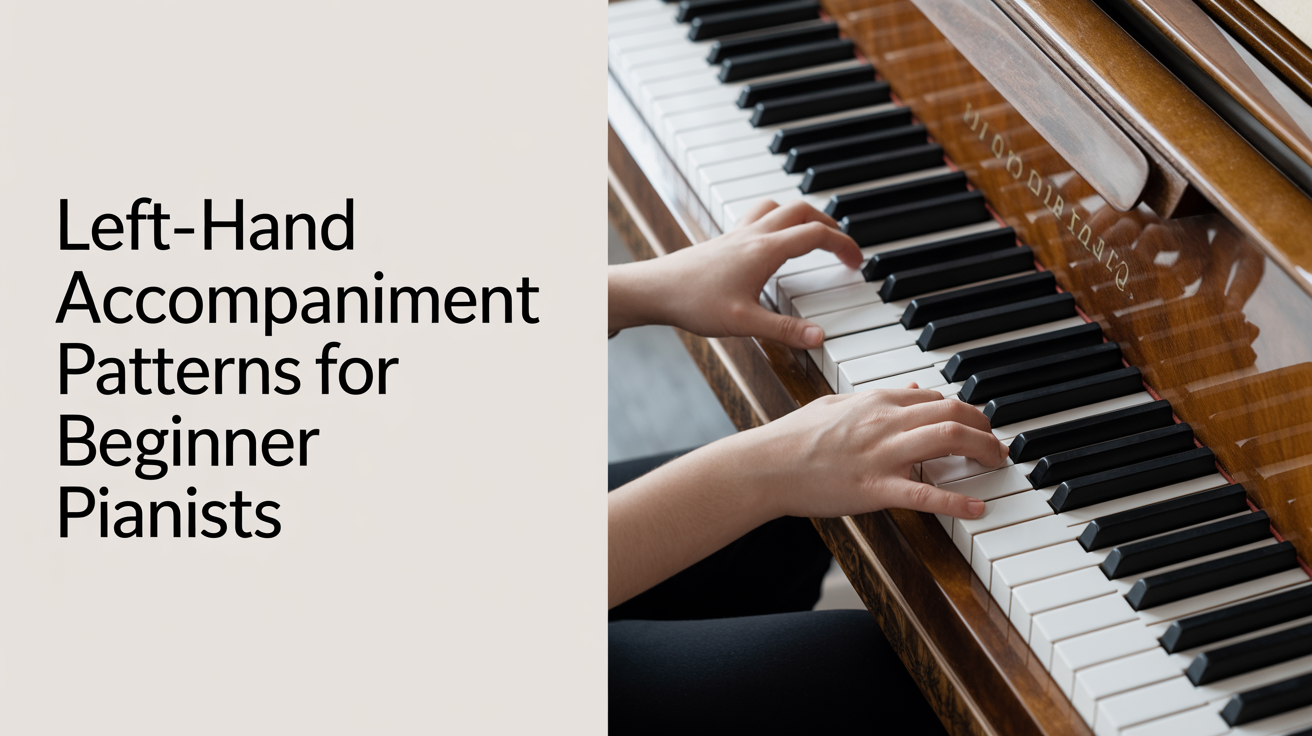
The left hand does more than hold chords. Once you can find a few basic chord shapes, you can start turning them into movement: a rhythm, a pulse, something that sounds like actual music rather than a sequence of blocks. This guide walks through the most practical left-hand accompaniment patterns for beginners, with clear finger guidance and realistic practice advice.
If you haven't yet worked through building your first chord shapes, start with basic triad construction and then come back here.
What Left-Hand Accompaniment Actually Does
In most beginner piano music, the right hand carries the melody while the left hand provides harmony and rhythm underneath it. That "underneath" work is called accompaniment.
The simplest accompaniment is a held chord: your left hand presses three notes at once and holds them while your right hand plays a tune. That works fine for slow pieces, but it can sound static. Patterns give the same chord rhythmic life without adding new notes to learn.
Three patterns cover the vast majority of beginner sheet music:
- Root-fifth (or root-chord) bass: single notes or a two-note interval on the beat
- Broken chords: the notes of a chord played one at a time, low to high
- Alberti bass: a specific broken-chord pattern of bottom, top, middle, top
Each pattern uses the same chord tones you already know. You're not learning new harmony; you're choosing how to deliver it.
The Root-Fifth Pattern
This is the most common starting point for left-hand piano accompaniment. Instead of playing a full chord, you play just two notes: the root (the bottom note of the chord) and the fifth above it.
For a C major chord, that means C and G. For G major, that means G and D.
C major root-fifth (left hand, bass clef):
C (finger 5) --- G (finger 1 or 2)
Play the root on beat 1, then the fifth on beat 2 (or beats 2 and 3 in 3/4 time). This gives you a clear bass pulse that supports any melody without crowding it.
Practice step: Pick one chord you know well. Set a slow metronome (around 60 bpm). Play root on beat 1, fifth on beat 2, root on beat 3, fifth on beat 4. Keep your wrist relaxed and let each note ring briefly before lifting.
Once you can do that with one chord for 30 seconds without stopping, move to two chords and practice switching.
Broken Chords: Playing Notes Individually
A broken chord spreads the notes of a chord across time instead of sounding them all at once. If you know a C major triad (C, E, G), a broken version simply plays C then E then G in sequence.
This is one of the most versatile left-hand patterns piano players use across folk, pop, and classical styles.
C major broken chord (ascending):
C --- E --- G --- E --- C --- E --- G --- E
(1)  (2)  (3)  (4)  (1)  (2)  (3)  (4)
The descending version (G, E, C) works just as well. Many pieces combine both directions.
Fingering tip: Use fingers 5, 3, 1 for a root-position triad (pinky on the lowest note, thumb on the highest). This keeps your hand arched and gives you a consistent shape across chords. See piano chords for beginners for a review of root-position shapes.
A common problem: New players often rush the broken chord, speeding up as they ascend. Record yourself (your phone works fine) and listen back. If the spacing sounds uneven, slow the metronome down two notches and play each note deliberately until the rhythm is automatic.
Alberti Bass: The Classical Three-Note Pattern
Alberti bass is a specific broken-chord pattern named after an 18th-century Italian composer. It became a staple of Classical-period piano music and still shows up often.
The pattern moves: bottom note, top note, middle note, top note. For a C major triad in root position that means:
Alberti bass on C major (left hand):
C --- G --- E --- G --- C --- G --- E --- G
(1)  (2)  (3)  (4)  (1)  (2)  (3)  (4)
The alternation between the bass note and the upper notes creates a rocking motion that sounds more active than a broken chord ascending from low to high.
Why beginners find this tricky: The jump from the top note back down to the root on beat 1 of the next measure can catch you off-guard. Isolate just that transition: play G, then jump to C, then G again. Repeat that three-note loop until the distance feels natural before adding the full pattern.
Alberti bass works well in moderate-tempo pieces. At very slow tempos it can sound clunky; at fast tempos it demands clean technique. Start at a speed where each note is clear and even, then increase gradually.
How to Practice Moving Between Chords
Knowing a pattern on one chord is one thing. Using it while changing chords is where the real work happens.
A common beginner exercise: take a I-IV-V-I progression in C major (C, F, G, C) and apply the same pattern to each chord. Move through the progression one chord per measure.
Pattern: root - fifth - root - fifth (4/4 time)

Measure 1: C - G - C - G  (C major)
Measure 2: F - C - F - C  (F major)
Measure 3: G - D - G - D  (G major)
Measure 4: C - G - C - G  (C major)
Practice the chord transitions with your left hand alone, no pattern, just moving from chord to chord on beat 1 until the shifts feel relaxed. Then add the pattern.
If you're not yet comfortable reading chord symbols, reading chord symbols and lead sheets explains the notation you'll encounter in most beginner sheet music.
A Quick Reference: Patterns by Feel
| Pattern | Notes used | Sound quality | Good for |
|---|---|---|---|
| Root-fifth | 2 notes (root + 5th) | Solid, simple | Very slow pieces, folk songs |
| Broken chord | All 3 chord tones | Flowing, smooth | Ballads, lullabies, pop |
| Alberti bass | All 3 chord tones, alternating | Active, classical | Moderate-tempo classical and hymns |
All three use the same underlying chord; only the delivery changes.
Frequently Asked Questions
How do I coordinate my left and right hands when using these patterns?
Practice each hand separately until the pattern is automatic, then layer them. A useful trick: play your left-hand pattern four times in a row while counting aloud, then add the right hand on the fifth repetition without stopping the count. The left hand needs to feel like breathing before the right hand joins.
Which pattern should I learn first?
Start with the root-fifth pattern. It has only two notes to manage, so you can focus on rhythm and chord changes rather than hand position. Once that feels easy, move to broken chords, then Alberti bass.
My left hand keeps getting louder than the melody. How do I fix that?
This is one of the most common beginner coordination issues. Try playing your left hand at about half the volume you think sounds right, then add the right hand. The melody almost always needs to be noticeably louder than the accompaniment. Practice the left hand alone at a noticeably softer dynamic until that softer touch becomes the default.
Can I use these patterns in any key?
Yes. The shape of each pattern stays the same; only the chord tones shift. If you know a G major triad is G-B-D, the broken chord version is simply G, B, D in sequence. Start in C major because the notes are easier to find, then move the same pattern to G major or F major once it feels comfortable.
How long until these feel natural under my fingers?
That depends heavily on how often you practice and how slowly you start. Most beginners find a single pattern starts to feel automatic after five to ten short sessions (10 to 15 minutes each) of focused, slow repetition. Rushing the tempo early is the main reason progress stalls; consistency matters far more than speed.