Getting Started
Correct Piano Posture, Bench Height, and Hand Position for Beginners
Learn how to sit at the piano correctly, set your bench height, and shape your hands for comfortable, injury-free playing from day one.
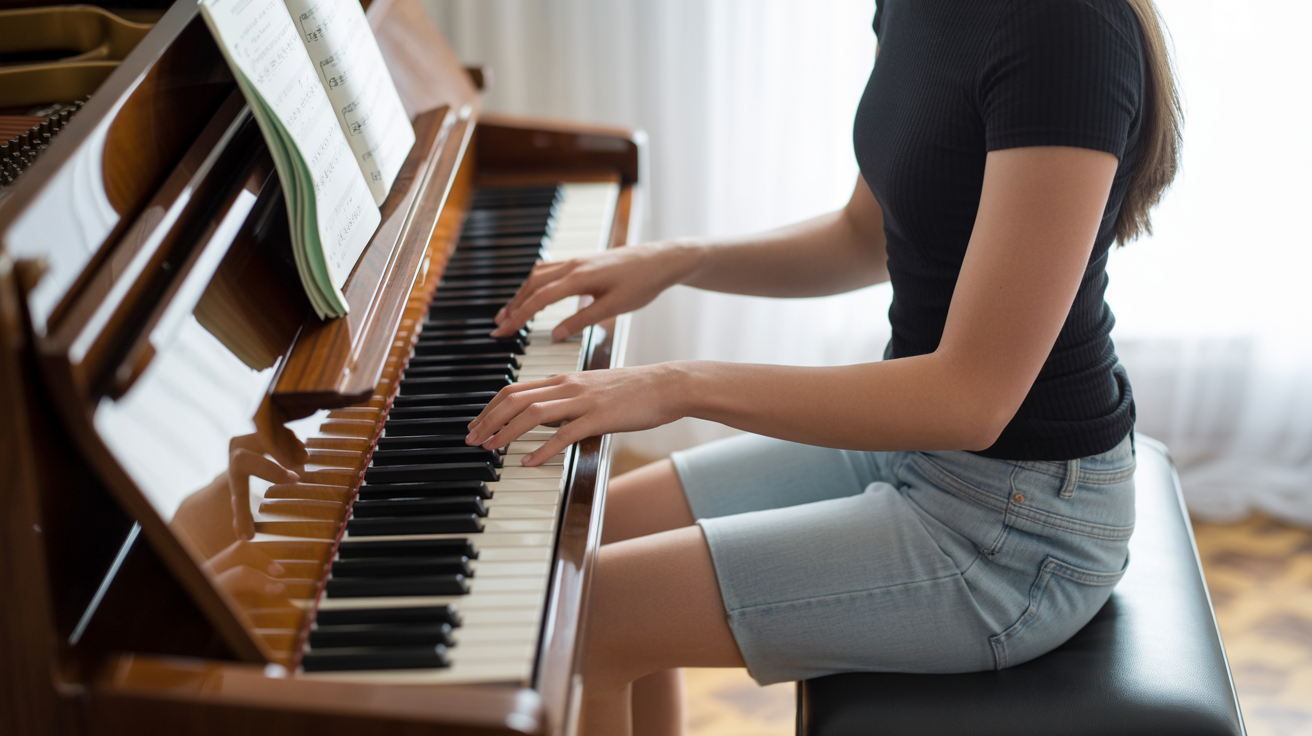
Correct piano posture is one of those things nobody warns you about until something starts to ache. Before you learn your first chord or scale, five minutes spent getting your bench height, sitting position, and hand shape right will save you a lot of frustration later. Here is what actually matters and how to check it for yourself.
How to Sit at the Piano
Sit toward the front third of the bench, not pressed against the back of it. You want your hips slightly in front of your knees, with your feet flat on the floor or resting on the pedals. If your feet dangle, a small footrest or a stack of books works fine.
Your torso should be upright but not rigid. Imagine a loose straight line from your hips to the top of your head. Do not lean toward the keys or hunch your shoulders forward. The music stand is there for your eyes, not your nose.
Keep a small gap between your thigh and the underside of the keys. If you are pressed against the keyboard, scoot back a few inches. You need freedom to reach the full width of the keyboard without twisting at the waist.
Quick posture check: Stand up, let your arms hang loosely at your sides, then sit down again. The way your arms hang is roughly where they should land when you play.
Setting the Right Piano Bench Height
This is the adjustment most beginners skip, and it makes the biggest difference. The goal is to have your forearms roughly parallel to the floor or angled very slightly downward toward the keys. Your elbows should be at about the same height as the keyboard, not above it or below it.
To find your height:
- Sit on the bench with your arms relaxed at your sides.
- Raise your hands and rest them lightly on the keys.
- Check whether your wrists are level with, or just slightly above, the tops of the white keys.
- If your shoulders are raised or your elbows are pointing down sharply, the bench is too low. If your wrists are drooping well below the keys, it is too high.
Most piano benches have a knob or bolt on each side for height adjustment. On a keyboard stand, the legs usually have pin holes at different heights. Adjust one side at a time and recheck.
Standard bench height for most adults lands somewhere between 18 and 21 inches from the floor, but your actual number depends on your torso length and arm proportions. Measure against your body, not a chart.
Piano Hand Position for Beginners
The classic beginner cue is to imagine holding a small orange or a tennis ball. Your fingers should be gently curved, not flat and not gripping tightly. Each fingertip lands on the key at roughly a 45-degree angle.
A few specifics:
- Fingers curved, not flat. Playing with flat fingers reduces control and can strain the tendons over time.
- Wrists neutral. Your wrist should float slightly above the keys, not collapsed onto the edge of the keyboard or cranked upward. Think of water flowing under a low bridge.
- Thumb angled in. The thumb plays on its side tip, not its pad. If your thumb is lying flat, rotate your hand slightly outward.
- Knuckles raised. The knuckles at the base of each finger should form a gentle arch. If they collapse inward when you press a key, slow down and play more lightly until the shape holds.
You do not need to exaggerate the curve. A gentle, relaxed arch is correct. Tension is the enemy, not looseness.
Arm Weight and Avoiding Tension
Beginners often press keys using only their fingers, which leads to tightness in the hand and forearm surprisingly fast. A more sustainable approach uses the natural weight of your arm.
Let your arm hang from the shoulder with no effort. Now transfer that weight through a relaxed wrist into one fingertip as you press a key. The key will go down with very little muscular effort. This is arm weight playing, and it is what most piano teachers mean when they say "play from the shoulder."
Practicing slowly with a light touch trains this. If your forearm feels tense after a few minutes of playing, stop and shake your hands out gently at your side. Tension that builds up and then you push through is the pattern that leads to repetitive-strain problems. Stop and rest before that point.
Common Posture Mistakes and How to Fix Them
| Mistake | What it looks like | Fix |
|---|---|---|
| Bench too far from keys | Leaning forward, arms stretched | Move bench 2-3 inches closer |
| Bench too low | Shoulders raised, elbows above wrists | Raise bench or add a cushion |
| Flat fingers | Keys pressed with finger pads | Curve fingers, slow the tempo |
| Collapsed wrists | Wrist resting on keyboard edge | Float wrist above the keys |
| Tense shoulders | Shoulders up near ears | Pause, roll shoulders back and down |
| Thumbs pressing flat | Thumb pad on key, not tip | Rotate hand slightly outward |
Check this table against what you see in a mirror or a short phone video. Video is often more honest than feel.
Frequently Asked Questions
How far from the piano should I sit?
Close enough that your elbows are slightly in front of your torso when your hands are on the keys, not pinned against your sides. A rough guide: if you extend one arm and tap middle C, your elbow should have a gentle bend, not be fully straight. Adjust the bench forward or back until that feels natural.
Does posture matter if I am just playing for fun?
Yes, but not in a perfectionistic way. Poor posture does not immediately cause harm, but after months of daily practice, a bench that is too low or flat fingers can create chronic tightness or overuse strain. Getting the basics right early costs nothing and removes a potential problem before it starts.
My bench does not adjust. What should I do?
A firm cushion adds height; sitting on a folded blanket works in a pinch. To lower a non-adjustable bench, you cannot really do that without replacing it, but a keyboard stand is adjustable and relatively inexpensive. For a child who needs a lower surface, some teachers use a booster cushion and a footrest together.
How do I know if my hand position is correct without a teacher?
Record a short video of your hands from the side while you play. Compare it to the descriptions above. The main signals: knuckles should form a gentle arch and not collapse when you press a key, wrists should float above the edge of the keyboard, and your arm from elbow to fingertip should form a smooth curve rather than sharp angles up or down.
Should I worry about this before I have learned any notes yet?
Yes, briefly. Spend ten minutes on posture before your first session. Then get on with learning notes and enjoying yourself. Check posture again if something starts to ache, or once a week as a quick habit. The goal is awareness, not obsession.
Setting up your physical relationship with the piano is a small task with an outsized return. Once your bench height feels right, your wrists float comfortably, and your fingers curve naturally, playing starts to feel more like playing and less like wrestling. From there, you are ready to start mapping the keys and reading your first notes.
If you have not yet sorted out which instrument to practice on, our guide to getting started with piano as a beginner covers the full picture. Choosing your instrument first also matters: the weight and width of the keys affects how posture habits transfer, so it is worth reading about digital piano vs keyboard vs acoustic before you invest. And if you are deciding how many keys your instrument needs, 61 vs 76 vs 88 keys explained will help you figure out what suits your goals.