Practice & Progress
How to Memorize a Piano Piece Step by Step
Learn how to memorize a piano piece with a clear, step-by-step method. Practical techniques for beginners to play piano from memory with confidence.
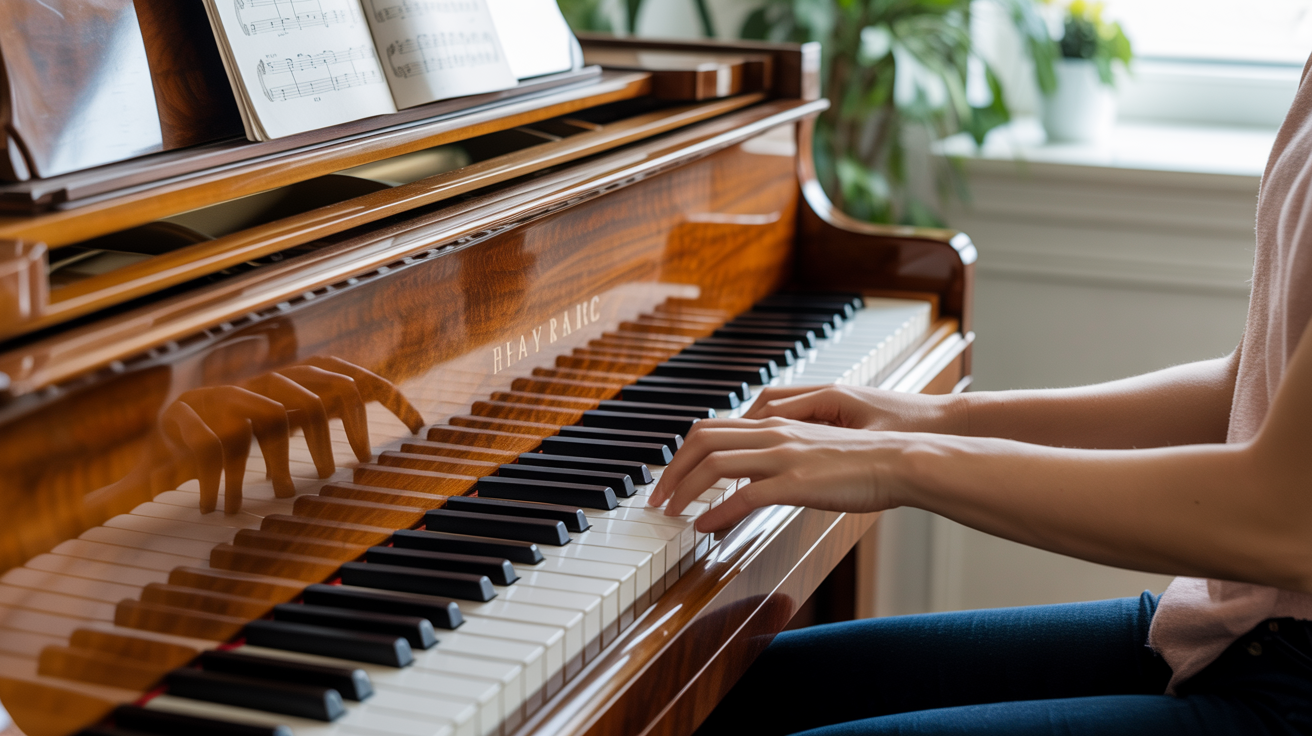
Most beginners assume memorization is something that just happens after you've played a piece enough times. That's the slow way. A more reliable approach is to build the memory deliberately, section by section, before you ever try to run through the whole piece. This guide walks you through that process in a sequence that actually sticks.
Why Rote Repetition Alone Doesn't Work
Playing a piece from start to finish over and over does eventually produce something like memory, but it's fragile. One small slip near the middle and you're back at the beginning because you've never practiced recovering from bar 16 on its own.
Real memorization means you could start at any phrase and keep going. It means your hands know where they're going even if your attention wanders for a second. That kind of memory requires multiple learning pathways working together, not just muscle habit.
The four pathways most pianists rely on are:
- Motor memory - your hands learn the physical patterns
- Aural memory - you hear what comes next before you play it
- Visual memory - you picture the score or your hands on the keys
- Analytical memory - you understand the structure of what you're playing
Strong memorization means at least two of these are carrying the piece at any given moment. If one fails under pressure, another takes over.
Step 1: Learn the Piece in Small Sections Before You Memorize Anything
Trying to memorize a piece you haven't learned yet adds two difficult tasks on top of each other. First, get the notes under your fingers with the score in front of you.
Divide the piece into sections of four to eight bars. Learn each section hands separately at a slow tempo until the notes feel familiar. Then put the hands together, still slowly, until each section is clean.
Only move to memorization once a section sounds roughly as you want it to. This is not the time to be perfect, just the time to know the notes. A consistent daily practice structure makes this stage much easier because you're not trying to cram everything into one session.
Step 2: Memorize Section by Section, Starting from the End
This is the step most beginners skip, and it's the one that matters most.
Start with the last section of the piece. Play it until you can do it without looking at the score, then add the second-to-last section, and so on. This sounds backwards, but it has a practical effect: by the time you reach the end in any run-through, you've practiced it the most. The ending never gets shaky.
For each section, try this sequence:
- Play it slowly with the score, noticing what your hands are doing, not just what the notes are.
- Close the score and try it. When you get stuck, open the score, find exactly where you stopped, and look at just those two bars.
- Play those two bars in isolation until they're automatic, then back up two bars before them and run from there.
- Once the section feels solid, add the previous section and play both together.
Work through the piece this way until you can play all the sections in order without the score.
Step 3: Practice Starting from Random Points
After you can play the whole piece from memory, test whether the memory is real or fragile by starting from different places.
Pick a bar number at random and try to begin there. If you can't start without running from the top, the memory for that spot is essentially just motor habit flowing from what came before. That habit will fail you when you lose your place on stage or get distracted.
Use the score to find any spots where you can't start cold. Isolate those spots and practice them as entry points. Once you can begin from anywhere in the piece and keep going, the memorization is genuinely solid.
Step 4: Use Analytical Memory to Fill the Gaps
Look at the score with the goal of understanding what's happening musically, not just where the notes are. Analytical memory gives you a backup when your hands hesitate.
A few things worth noting in most beginner pieces:
- Where does the melody repeat or nearly repeat? If bar 5 is almost identical to bar 21, you only need to learn one of them plus the small differences.
- What are the chord shapes in the left hand? If the left hand is playing I, IV, V in C major across most of the piece, you don't need to memorize individual notes; you're memorizing chord positions.
- Where are the phrase boundaries? Knowing that a phrase ends at bar 8 and a new one begins at bar 9 gives you a structural map you can navigate by ear.
Spending ten minutes with the score analyzing the piece this way can save hours of repetition.
Step 5: Test Your Memory Away from the Keyboard
A reliable memorization technique for piano is mental practice, sometimes called "silent practice." Close your eyes and play through the piece in your mind, hearing each note and feeling what your hands would be doing.
When you get stuck mentally, that's exactly where the memory is weakest. Go to the keyboard and work on that passage directly.
Mental practice also works well during short breaks. If you're keeping your practice sessions to an appropriate length, you'll naturally have gaps during the day when you can sit quietly and run through the piece internally. This counts as real practice.
The Tempo Problem: Memorizing Slowly Versus Playing at Speed
Many beginners memorize a piece at a slow tempo and then find that playing it faster feels like learning it over again. The muscle patterns at slow tempo and fast tempo are genuinely different, so this isn't surprising.
Once you have a section memorized at slow tempo, bring it up in small increments. A useful approach from slow-practice technique applies here: practice at the speed where you can play the notes cleanly, then nudge the tempo up by a small margin and repeat. Do this in short bursts, not marathon sessions.
If a fast passage keeps breaking down, slow it down and memorize it again at that slower speed, then rebuild the tempo. The memory at speed is a different skill than the memory at slow tempo, and it needs its own practice time.
Quick-Reference: Memorization Techniques for Piano
| Technique | What It Builds | When to Use It |
|---|---|---|
| Hands-separate slow practice | Motor memory | Early learning stage |
| Backward chaining (end first) | Even motor memory across the piece | After learning notes |
| Random-start practice | True memory, not just habit flow | Once piece is playable |
| Score analysis | Analytical memory | Any time, even at the keyboard |
| Mental practice | Aural and visual memory | Breaks, away from piano |
| Tempo-increment practice | Memory at performance speed | After slow memorization |
Frequently Asked Questions
How long does it take to memorize a piano piece?
That depends heavily on the length and difficulty of the piece and how much time you practice each week. A short beginner piece of 16 to 32 bars, practiced daily for 15 to 20 minutes, might take two to four weeks to memorize well. Rushing that timeline usually produces fragile memory that falls apart under pressure.
Should I memorize hands separately or together?
Learn hands separately first with the score, then put them together before starting to memorize. Once you begin memorization, work in short sections hands together. Memorizing hands separately and then combining them at the end creates coordination problems that are hard to fix later.
What do I do when I blank out during a performance?
This happens to everyone. Having a few reliable starting points throughout the piece helps, since you can skip ahead to one if you lose your place completely. More practically: slow down slightly when you feel uncertain, and trust your hands to find the next pattern. They often know the piece better than your conscious mind does. The more you've practiced starting from random points, the better equipped you are to recover.
Is it better to memorize one piece at a time or several?
For most beginners, focusing on one piece for memorization while keeping a second piece as sight-reading or technique material works well. Spreading memorization effort across too many pieces at once tends to leave all of them half-learned. Once the first piece is genuinely solid, you can move the second one into the memorization process.
What if I keep forgetting the same spot?
That spot needs isolated attention, not more full run-throughs. Identify exactly which bar causes the problem, then play just that bar and the two bars before it until they're automatic. The issue is usually a jump in the hand position, an unexpected chord, or a rhythm that you haven't fully internalized. Analyze what's tricky about it specifically rather than hoping repetition will eventually smooth it over.