Practice & Progress
How to Stay Motivated and Avoid Quitting the Piano
Feeling like giving up? Here are honest, practical ways to stay motivated learning piano and keep making progress even when it gets hard.
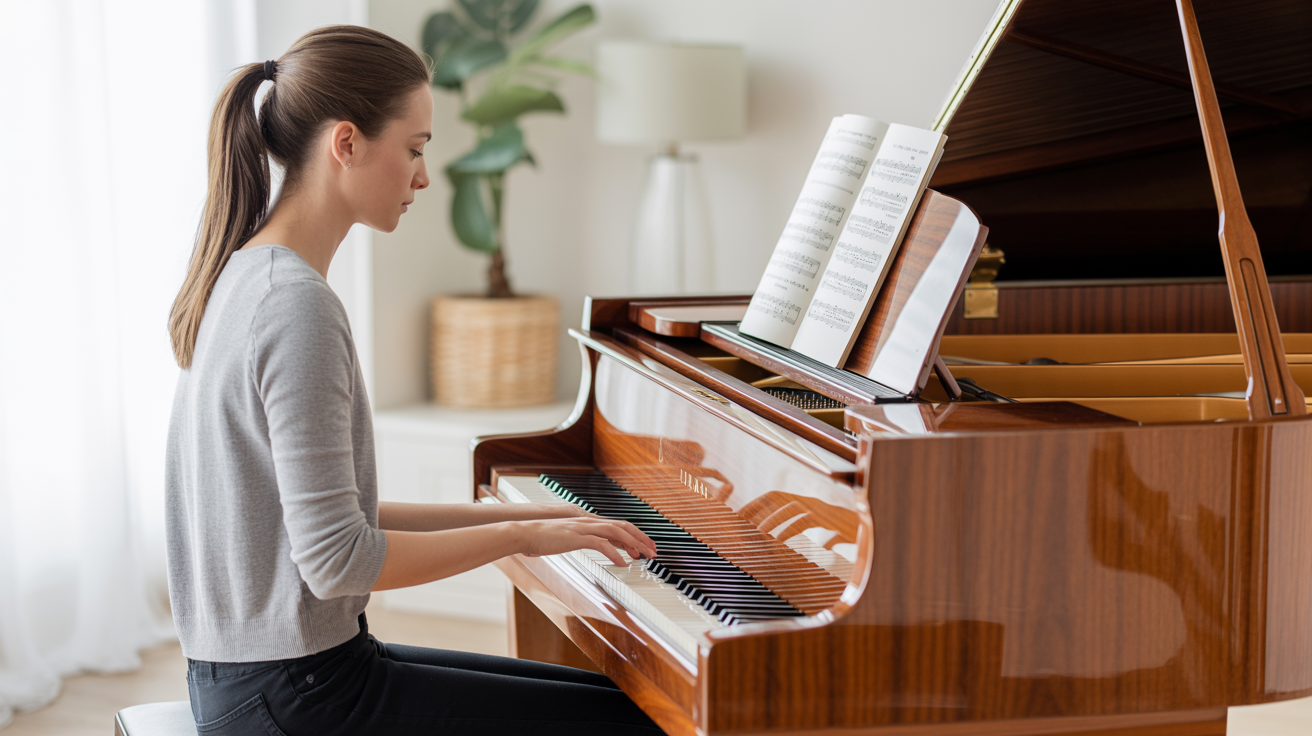
Most people who quit the piano do so in the first six months. Not because they lack talent, but because progress slows, life gets busy, and sitting down at the keys starts to feel like homework. If you've recently thought "I want to quit piano," you're in good company. The good news is that the urge to quit is almost always temporary, and there are specific, concrete things you can do to get through it.
Why Motivation Drops (and Why That's Normal)
Piano learning has a predictable shape. The first few weeks feel exciting: you learn where the notes are, you play your first melody, things click quickly. Then somewhere around weeks four to eight, progress slows. The easy wins dry up. Songs that seemed close still have rough spots.
This phase has a name in skill-acquisition research: the "valley of frustration." It happens in every long-term skill, not just piano. Recognizing it as a phase rather than a signal that you're "not a piano person" is the first step to pushing through it.
A few common reasons motivation drops for beginners:
- Practicing the same stuck spot over and over without a clear plan for fixing it
- Sessions that are too long, leaving you drained rather than energized
- No sense of what you're building toward, so each practice feels disconnected from progress
- Comparing your playing to recordings of professional pianists
None of these are signs you should quit. They're signs you need to adjust your approach.
Set a Goal That's Close Enough to See
Abstract goals like "get good at piano" don't sustain motivation. A goal you can see in the next two to four weeks does.
Pick one short, specific target: finish the first eight bars of a song you like, play a C major scale with both hands together at 80 bpm, or learn the left-hand pattern for a chord progression you enjoy. Write it down. When you sit down to practice, you know exactly what you're working on and what "done" looks like.
Once you hit that goal, take a moment to notice it before moving on to the next one. Small wins compound.
If you're not sure how to structure these sessions, how to build a daily piano practice routine that works walks through a repeatable format that keeps sessions purposeful.
Shrink Practice to What You Can Actually Do
One of the fastest ways to kill piano practice motivation is to set a daily commitment that's too ambitious. You miss a day, feel guilty, skip another, and then the piano starts to feel like something you've already failed at.
Fifteen minutes of consistent, focused practice beats a forty-five-minute session three times a week with long gaps in between. Consistency is what builds the neural pathways that make playing feel natural.
If you're struggling to find time, read how long should beginners practice piano each day. The answer is probably shorter than you think, and that's actually good news.
The goal is to make the habit of sitting down at the piano feel automatic, not heroic. Once the habit is stable, you can extend the length if you want to.
Use Slow Practice to Feel Progress
When a passage isn't working, the temptation is to run it at full speed and hope it sorts itself out. It usually doesn't. What does work is slowing down enough that your hands know exactly what they're supposed to do, then building speed gradually.
This approach has a counterintuitive side effect: you notice improvement faster. A passage you could barely play at 60 bpm last Tuesday might feel solid at 80 bpm by Friday. That kind of measurable change is genuinely motivating in a way that "I played the whole song but made lots of mistakes" is not.
How to practice piano slowly and why it works covers the mechanics if you want specifics.
Play Things You Actually Like
This sounds obvious, but it's easy to drift into practicing only what your method book or app assigns, especially if you're self-teaching. If none of what you're playing sounds like something you'd voluntarily listen to, motivation will fade.
Keep one "fun piece" in rotation alongside whatever you're working on technically. It doesn't have to be polished. It just has to be something you want to play. Even a simplified arrangement of a song you love gives sessions a sense of purpose that technical exercises alone can't provide.
If you play through that piece badly, that's fine. Play it again. Playing something for enjoyment is allowed.
Practical Ways to Keep Practicing Piano
Here's a quick reference for what to try when motivation slips:
| What's happening | What to try |
|---|---|
| Sessions feel like a chore | Shorten them to 10-15 minutes |
| Stuck on the same passage | Slow it down, isolate 4 bars |
| Nothing sounds good | Add one song you genuinely enjoy |
| Lost sight of progress | Record a short clip to compare later |
| Life got busy for two weeks | Start fresh, no guilt, shorter goal |
| Bored with current material | Learn a simpler version of something new |
Recording yourself, even just on a phone, is worth calling out separately. Most beginners are surprised to hear how much better they sound than they feel while playing. Progress is hard to notice in real time.
Frequently Asked Questions
Is it normal to want to quit piano after a few months? Very common. The first plateau usually hits somewhere in months two through four, when the initial novelty wears off and the work gets more repetitive. Most players who push through this period find that motivation returns once they start playing music that feels genuinely satisfying.
How do I get back into piano practice after a long break? Start shorter than you think you need to. A ten-minute session for the first week after a break is enough. Don't try to pick up where you left off on a difficult piece. Find something you could already play reasonably well, play through it a few times, and let the familiarity remind you why you started. The technique comes back faster than you expect.
Does switching songs every week help or hurt motivation? It depends on why you're switching. If a piece is genuinely too hard right now, finding something achievable is a good idea. If you keep switching every time a piece gets difficult, you'll avoid the practice that actually builds skill. A useful rule: finish at least a simplified version of each piece before moving on.
Should I take a break from piano if I feel burned out? A few days away won't hurt you and might help. A week is fine. If "a few days" consistently turns into months, the break isn't solving the underlying issue. Look at what's making practice feel like a burden and address that directly, usually by making sessions shorter or changing what you're working on.
How do I know if I'm making real progress? Progress at the piano is slow enough that it's hard to feel in the moment. The most reliable check is to record yourself playing the same piece six to eight weeks apart. The gap is usually obvious, even when daily practice feels like you're standing still.